Sri Lanka's Tamil farmers fight to reclaim land after civil war / Photo: Ishara S. KODIKARA - AFP
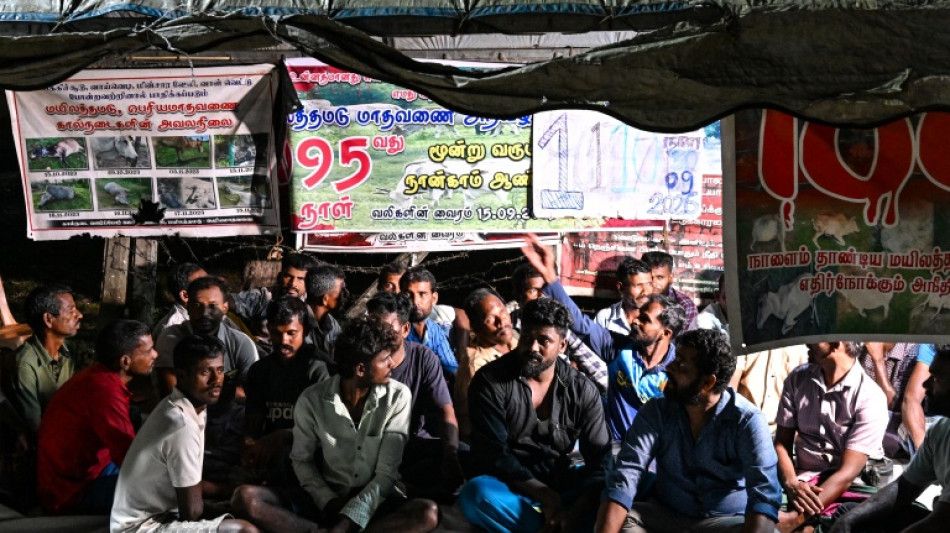
Tired but resolute, dozens of Tamil cattle farmers have held a round-the-clock vigil for almost three years in eastern Sri Lanka, protesting what they call land "theft".
At shift change, farmers exchange news before settling beneath a tarpaulin beside photographs of the bloodied bodies of their dead cows.
"They have been shooting our cattle, threatening us, assaulting us, and spraying pesticides or poison on the pasture lands where our cattle graze," said Seenithamby Thiyagarajah, president of the local farmers' association, detailing the push his community felt from recipients of a state-funded program that was driving them off their land.
"Over 5,700 cows have been destroyed like this. Even after complaining numerous times to the police and all relevant places, we received no resolution."
The alleged perpetrators are farmers who have benefited from the state-funded Mahaweli development scheme.
Most are Sinhalese, the country's majority ethnic group, settling on land claimed by the largely Hindu Tamil minority, which makes up about 12 percent of the population.
The government denied any forcible attempts to remove people from their land.
Sri Lanka's 1983-2009 civil war between government forces and Tamil separatists killed more than 100,000 people, according to the United Nations.
Nearly two decades later, land disputes continue to fuel ethnic grievances.
- 'You must leave' -
Thiyagarajah says settlers aided by the scheme have encroached on grazing land used by the roughly 1,000 cattle farmers he represents. Courts have repeatedly ordered the eviction of the scheme-backed settler farmers, he said.
"Things are peaceful, for a while," he said. "But then the illegal cultivators entered again, ruining our land and destroying our cattle."
Other communities are also fighting to reclaim land.
Ambalavar Nallathambi Velayutham, 64, an Indigenous community leader, wants his rice fields back.
Armed with renewed land deeds renewed with local authorities, Velayutham and neighbours in Kunjankulam returned to farming fields they had abandoned during the war.
Forest Department officials then told them the land was a reserve, according to Velayutham.
"We said; 'This land belonged to our ancestors'. They replied, 'That won't do. You must leave.'"
Fearing reprisals, most villagers abandoned their efforts.
One night, a villager spotted forestry officials' mobile phones glowing in the darkness.
"They dug there and planted boundary stones," Velayutham said, pointing to the markers.
Repeated appeals to local authorities, the prime minister and president have brought no result, he said.
"This land has neither been freed nor handed back to us," he said. "If they release this farmland and we get it back from the Forest Department, I believe this will provide a great opportunity."
Land disputes have multiplied across the Eastern Province, where Tamils are a major ethnic group.
Examples include an army barracks encroaching on a school, while government departments responsible for archaeology, wildlife or forests claim farmland, temples and private property.
Officials designate land cultivated by Tamils as forest or wildlife reserves, "obstructing development or agricultural activities for them", said Sabarathinam Sivayoganathan, 57, president of the Eastern Province Civil Society Activists Union.
The scale of these occupations is unclear, with no public statistics and residents risking intimidation by asking questions, he said.
- 'Frustration' -
Opposition MP Rasamanickam R. Shanakiyan says population figures point to a deliberate effort to change the region's demographics.
"In the Eastern Province, the Sinhala population has increased by 700 percent since independence in 1948," he said, compared with 200 percent nationally.
"This has happened through state-sponsored colonisation," he said, accusing the government of altering the ethnic balance of the north and east through land settlements.
President Anura Kumara Dissanayake's election in 2024 has brought little change, Shanakiyan said, despite campaign promises to the contrary.
He accused the government of failing to honour commitments in the lead up to the election that it would release land, protect minority rights and deliver wider political reforms.
"On these promises, nothing's been delivered," he said. "You feel a growing sense of frustration, maybe anger in the population."
Land ownership disputes continue to fuel tensions, resentment and accusations between Sinhalese and Tamils across eastern Sri Lanka, both online and on the ground.
The government says it has commissioned a report on changes to land records since the civil war and whether they should be corrected.
"We will never forcibly acquire people's land," Environment Minister Dhammika Patabendi told AFP in an email.
"Based on the recommendations of this report, we believe that these issues can be resolved promptly and fairly," he said.
But as torrential rain drums on the tarpaulin sheltering the angry farmers, Thiyagarajah remains unconvinced.
"For 1,010 days, alongside this road and under this tent, we have been taking part day and night. Justice has still not been granted to our people," he said.
"Today, our people live in constant fear that today or tomorrow our cattle will be destroyed."
L.Martinez--PI