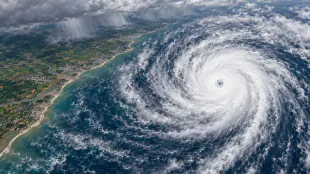
'Very dangerous' super typhoon nears US Pacific islands / Photo: Yuichi YAMAZAKI - AFP

People in Guam and the Northern Marianas moved to emergency evacuation centers and made last-minute preparations on Sunday, hours before a "super typhoon" was projected to bulldoze through the US Pacific territories.
Super Typhoon Bavi was forecast to roar westwards over the area from early Monday with winds of 260 kilometers per hour (160 miles per hour) -- equivalent to a category 5 hurricane -- and gusts of up to 315 kph.
The National Weather Service called the typhoon "very dangerous", warning of "tropical storm force" winds from Sunday afternoon or evening and "catastrophic" damage near the system's center later.
"Significant flooding from torrential rains, and coastal inundation are expected," the NWS said, with projected waves of up to 35 feet (10.7 meters) -– the height of a 10-storey building -- creating "extremely dangerous" conditions at sea.
Pinky Cubacub, 55, said as she boarded up the windows of her eatery in Guam that she had lined up early on Saturday morning to buy $500 worth of plywood at a lumber store.
"I cannot afford to lose so many days. It hurts," she told AFP. "Because I just started, whatever we're making right now is just for rent, utilities, and my people, and supplies. I don't even pay myself yet."
Call centre employee Arabella Paulino, 48, said: "My girls were saying to me it's scary. But it will be okay."
"My house is concrete, so the worst that can happen is a window could blow in," she told AFP.
Derma Soaladaob said she was going to a hotel.
"I have a concrete house but with the noise and the wind, it's scary," said the 51-year-old, who drives a school bus for the US military.
Japanese tourist Miku Sakurai, 25, was supposed to fly back to Tokyo with her friends on Sunday but their flight was cancelled because of the weather.
"We will stay in the hotel when the storm comes. I am scared," the office worker told AFP as heavy rain began to fall.
- 'Praying' -
The Northern Marianas in the western Pacific has a population of around 40,000, and nearby Guam -- a separate US territory, although both are part of the Marianas archipelago -- about 170,000.
Super Typhoon Sinlaku, which hit the region in mid-April, knocked out power for tens of thousands of inhabitants, uprooted trees, overturned cars and ripped metal roofs off buildings.
A cargo ship, the MV Mariana, suffered engine failure and overturned in the storm. The body of one crew member was recovered and five others were missing, presumed dead.
By Sunday morning, Bavi was forecast to pass nearest to Rota, a small island roughly halfway between Guam and Saipan, the Northern Marianas' main island and home to around 1,500 people.
"By working together and taking the necessary precautions, we can help protect our families, neighbors and community. We pray for the safety of our people," Rota mayor Aubry Hocog said.
Teams from the Federal Emergency Management Agency (FEMA) teams were on the ground in Guam and its distribution center was stocked with 1.1 million liters of water, 1.2 million meals, 6,700 cots and 90 generators.
The NWS said the "window to evacuate or seek shelter is closing", and Guam opened five evacuation centers in schools with total capacity of 1,900, primarily for those in vulnerable homes.
- El Nino -
The world's oceans experienced their hottest June on record and could set fresh highs in the months ahead, the European Union's Copernicus Marine Service said on Wednesday.
Warmer oceans help tropical storms to intensify and add more moisture, which can fall as heavy rain.
The World Meteorological Organization warned on Friday that El Nino, which typically occurs every two to seven years and lasts nine to 12 months, has already begun in the tropical Pacific and is likely to be strong.
The natural climate phenomenon warms surface temperatures in the central and eastern equatorial Pacific Ocean, bringing worldwide changes in winds, pressure and rainfall patterns.
W.Wright--PI