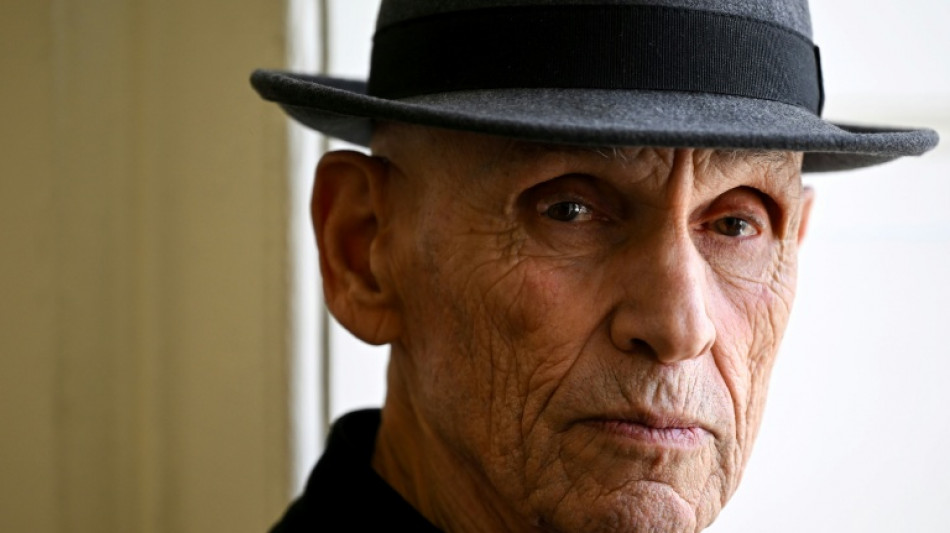
Famed photographer Joel Meyerowitz embraces camera phones / Photo: Justin TALLIS - AFP
Photographer Joel Meyerowitz, famous for capturing everyday life on the streets of his native New York and elsewhere, has no qualms about now sharing the stage with hordes of phone-wielding amateurs.
"The problems of the world and the joys of the world are visible because everyone has a camera," the 88-year-old told AFP.
The pioneer of colour images and so-called street photography is happy modern technology has given nearly everyone the chance to use the medium "as a means of expression".
"Nowadays... there are billions of people every day making photographs and there's a culture of imagery that is teaching people values about photography, about humanity, about dignity," he said.
Meyerowitz spoke at London's Somerset House, where photographs from his decades-spanning career go on show for 18 days from Friday as part of this year's Sony World Photography Awards Exhibition.
It has also honoured him with its annual "outstanding contribution to photography" award.
"It's thrilling to be recognised," he said, standing near his iconic pictures shot during a 1966-67 tour of Europe while a video projection presents a playful self-portraits project from 2020.
"When I began, it wasn't about a future in which I might win an award. It was about just doing the work... so I'm grateful."
- 'My city was hurt' -
Meyerowitz started his career as a painter and graphic designer before discovering photography just as colour imagery was emerging.
"The world is in colour -- it didn't even occur to me that I should use black-and-white," he recalled.
That budding photographer of the early 1960s also immediately embraced the urban environment.
"When I went onto the street, I never looked back," Meyerowitz said.
"The energy of life in the street, the way people carried themselves, the interactions between people, instantaneous events happening and disappearing -- photography is about that."
Street pictures aside, Meyerowitz is equally well known for documenting Ground Zero following the September 11, 2001 attacks -- the sole photographer to have continued access to the site in the year after 9/11.
He spent several years creating an archive comprising 8,500 images, some of which were exhibited and feature in a book, "Aftermath: World Trade Center Archive".
Twenty-five years on, he recalled how the "life-changing" experience began from a desire to help -- as well as an act of defiance after then-mayor Rudy Giuliani barred photographers from the site.
"I'm a native New Yorker. My city was hurt. I needed to help in some way. I didn't know how... and then I figured it out," he explained.
"I thought 'screw you, buddy. We need this. This is history here. This is happening in America, in New York City, and you're saying no photographs?'
"So I just decided I'm going to go in there and do the work that was necessary that he was trying to ban."
Meyerowitz initially forged a worker's pass, before eventually befriending detectives on-site and securing a police department access badge.
"I wanted to get in bad enough... I'm glad I did it."
- No to AI -
Meyerowitz noted a constant hallmark of his career has been embracing technological innovation, from the adoption of colour at the outset to digital cameras decades later.
But he has opted against exploring AI's growing reach.
"I'm not at a point in my life where I want to go into the artificial intelligence route," he said.
"You might say (it's) lens-less photography. We'll know in the future what this means right now. I've chosen not to use it."
Despite that, London-based Meyerowitz, who is also editing all his unseen work for two new books, is still innovating.
The celebrated octogenarian is currently working on a project "very unlike anything I've ever done" that involves "not just making a straight photograph", he said.
"I'm not going to talk about it because it's, first of all, very risky -- culturally risky, I think -- and I haven't fulfilled it yet. I'm at work on it."
L.Lewis--PI