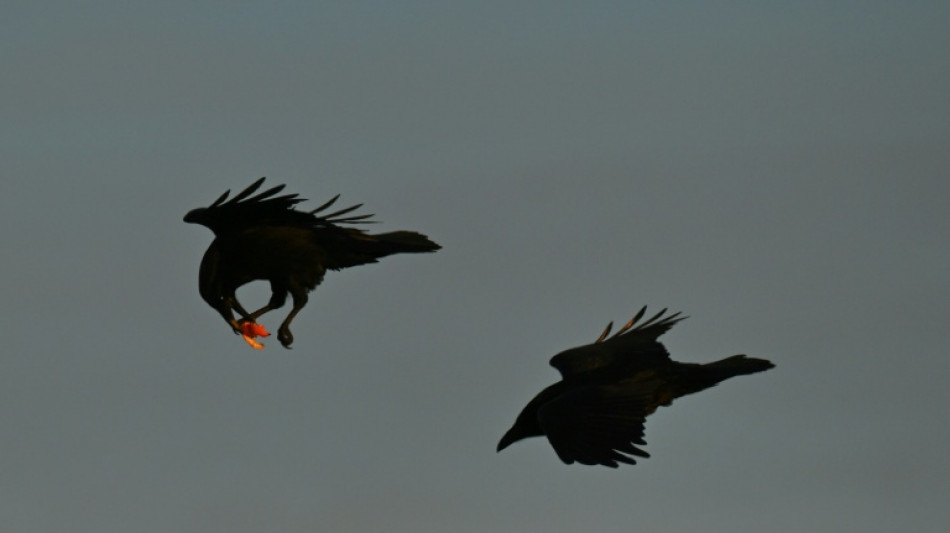
Scavenging ravens memorize vast tracts of wolf hunting grounds: study / Photo: Ina FASSBENDER - AFP

The partnership between ravens and wolves goes back to Norse mythology -- Odin's birds scouted ahead and led prey to the god's canines, a relationship that provided food for all.
The myth has some roots in reality: when wolves have a successful hunt, ravens are often observed first on the scene -- and new research published Thursday in the journal Science put the legend to the test.
The study's findings suggest the birds are doing more than just tracking the hunters: they're using navigation and spatial memory techniques to scavenge with sophistication.
While "ravens are already well-known for their intelligence," lead author Matthias-Claudio Loretto told AFP, seeing these cognitive abilities "play out at a much larger scale in the wild" produced startling results.
Ravens weren't just following wolves -- they were clocking kill patterns, creating mental maps to support future food quests.
The international research team attached tiny GPS trackers to 69 ravens -- an impressive number considering the painstaking work in trapping the particularly observant birds.
"Even small changes in their environment can make them suspicious," said Loretto, who is at the University of Veterinary Medicine in Vienna, and began the research at the Max Planck Institute of Animal Behavior.
The team had movement data from 20 collared wolves in the famed Yellowstone National Park, a vast protected area in the western United States where wolves were reintroduced in the mid-1990s after 70 years of absence.
The park was uniquely suited to the study.
"This work would not have been possible anywhere other than Yellowstone," said co-author and wildlife scientist John Marzluff of the University of Washington.
Because the environment is open rather than densely wooded, both the birds and wolves are relatively easy to observe at long distances, he told AFP.
- 'Sophisticated' animal cognition -
Over two-and-a-half years of monitoring, researchers were puzzled to find just one instance of a raven following a wolf for more than an hour -- even as the birds were still able to quickly arrive at a kill.
Deeper analysis showed ravens were in fact revisiting spots where wolves commonly took down prey -- animals like deer, elk or bison -- suggesting the birds were creating and memorizing a "resource landscape."
Some birds would fly nearly 100 miles (up to 155 kilometers) in a single day, seeking out places they seemed to expect might feature wolf kills.
It was "a much larger area than I ever imagined," said Marzluff.
Short-range cues still matter: ravens might be following signals like wolf howls to find fresh kills at shorter distances.
But broadly speaking, the researchers said ravens were counting on their memory to lead the search.
Wolf kills aren't distributed at random, Loretto said, occurring more often on flatter terrain or in open valleys where chases are more likely.
Ravens might remember past feeds or notice indirect signs like bones as they establish their mental maps.
"Animal cognition in the wild may sometimes be more sophisticated than we tend to assume," Loretto said.
- Raw deal -
The wolf-raven relationship is sometimes described in popular culture as harmonious, but Marzluff said it's ultimately pretty lopsided.
Wolves have been observed swatting the birds away, even appearing to designate a pack member to stand guard.
The birds noisily fight over their stolen feast, a potential tip-off to other scavengers.
And a single raven can carry off half a pound (220 grams) of meat. When the birds arrive in the dozens, that can make even a downed bison disappear quickly, Marzluff said.
"Ravens get a lot more out of this deal than wolves do," he added.
The scientist said he hopes future research could focus on how young birds develop their knowledge.
"Ravens have fascinated people forever," Marzluff said, noting the birds have been considered everything from "creators and tricksters" to "opportunistic pests."
But "never did we anticipate or expect them, I think, to be able to hold in their brains, which aren't much bigger than your thumb, information over thousands of square miles," he said.
"We've underestimated them."
B.Lee--PI