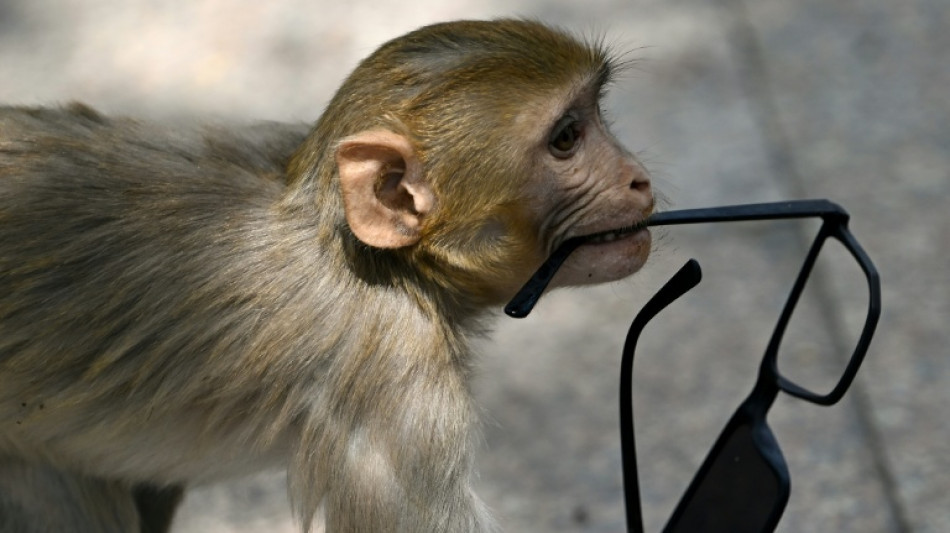
No monkey business: India 'whisperers' guard world championships / Photo: Sajjad HUSSAIN - AFP

As top badminton players descend on New Delhi for the world championships, an unusual band of men have their eyes fixed not on the stars, but on monkeys lurking around.
Nazar Khan, 65, is among a four-member team of "monkey whisperers" hired to stop rhesus macaques from gatecrashing the showpiece event, which begins Monday at the Indira Gandhi Indoor Stadium.
The venue has an unenviable reputation.
During the India Open in January a monkey was spotted in the stands, while bird droppings and debris from a nest disrupted play, drawing widespread criticism.
Determined to avoid a repeat of the embarrassment, organisers have turned to a popular fix for the problem -- "monkey wallahs" or men who imitate the calls of langurs, the natural enemy of the smaller primates.
"We are running this business for generations, starting with street shows of monkeys and bears," Khan told AFP.
"But then it was banned and to keep our pot burning we took to driving away monkeys, and here we are. We kept langurs with us but then they were also banned."
Though revered in the majority Hindu nation, monkeys are a major menace in the capital, often trashing gardens, offices and residences and even viciously attacking people for food.
For decades monkey handlers armed with trained black-faced langurs were seen shooing away the smaller primates on the streets.
But that practice ended after a court ruling barred the capture and use of the animals.
That left families such as Khan's relying on little more than experience, sharp eyes and an assortment of convincing animal noises.
"There are three-four monkeys and two fat ones who many say are dangerous," Khan said about the animals roaming the venue that will stage the badminton.
"But we make specific noises that drive them away. We know our stuff."
- Screeches and growls -
Khan said their job extends beyond primates.
"We also have to keep away stray dogs... we catch them and take them out of the stadium," he said. "But we make sure no animal is harmed."
He proudly added that his grandson was part of a team tasked with keeping monkeys away from the office premises of Indian Prime Minister Narendra Modi.
His nephew and fellow monkey wallah, Faryad Ali, eagerly demonstrated his trade, unleashing a rapid sequence of hoots, screeches and growls.
The work comes with occupational hazards.
"There are perils in this profession and sometimes we get bitten as well," Ali told AFP, showing bite scars at the back of his torso.
"But it's all part and parcel of our trade. We get bitten and move on. No injections, nothing. Just chilli powder on the wound and we are back in action."
News that monkey whisperers had been deployed for badminton's premier event prompted ridicule online.
"You can laugh at the solution, but you have to love the effort," Indian star and Olympic medallist P.V. Sindhu wrote on X, defending the move.
Sindhu compared the arrangement to Wimbledon, where Rufus the hawk has long been used to keep pigeons away from the famous grass courts.
"Every major sporting event has its own local challenges," she said. "This is just one additional measure on top of the countless measures already being taken."
Tournament organisers say the unusual workforce is only one part of a broader plan to avoid the disruptions that marred January's India Open.
A non-toxic gel has been applied to roof structures and ducts to prevent pigeons from sitting there.
Badminton Association of India secretary Sanjay Mishra said officials were taking no chances.
"I am 100 percent sure that this time the pigeon-related or any kind of bird and animal-related problems will not occur during the world championship," he said.
E.Perez--PI