History-maker Sawe shatters marathon glass ceiling / Photo: JUSTIN TALLIS - AFP

Kenya's Sabastian Sawe on Sunday shattered one of the most elusive barriers in athletics, becoming the first man to dip below the two-hour mark in the marathon.
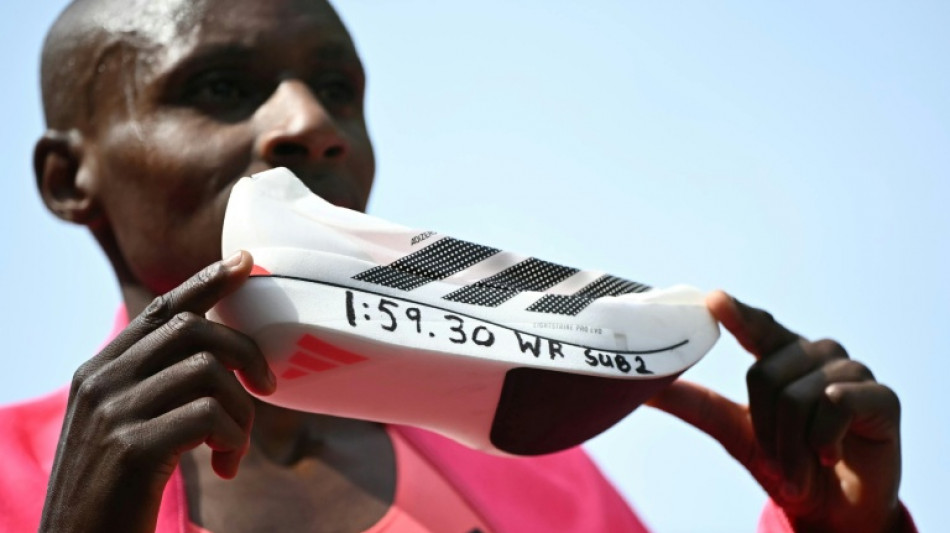
Sawe, sporting state-of-the-art running shoes and spurred on by second-placed Yomif Kejelcha of Ethiopia, clocked a barely believable 1hr 59min 30sec to retain his London crown.
It shattered by 65 seconds the previous best of 2:00:35 set in Chicago in 2023 by the late Kelvin Kiptum.
"The goalposts have literally just moved for marathon running and where you benchmark yourself as being world class," said BBC pundit Paula Radcliffe, who held the women's marathon record of 2:15:25 from 2003 to 2019.
"I did think that mark could be beaten but not today.
"It is a lesson to everybody out there. We say don't go out too fast and they went out smartly and paced it really well. Smart racing brought it to the line."
The two-hour barrier has long been a goal of increasing numbers of elite marathon runners, not least Kenya's Eliud Kipchoge.
In October 2019, Kipchoge famously broke that barrier as he timed 1:59:40 on the streets of Vienna.
But the time was not ratified as a world record because he ran with specialised shoes, standard competition rules for pacing and fluids were not followed, and it was not an open event.
Kenyan Paul Tergat's time of 2:04.55 in the 2003 Berlin Marathon was the first ratified world record over the 26.2-mile (42.2-km)distance.
Ethiopian Haile Gebrselassie twice bettered that mark, both times in Berlin, dipping under 2:04.00.
The record then swung back into Kenyan hands, first with Patrick Makau and then Wilson Kipsang and Dennis Kimetto setting new marks.
Kipchoge then set new standards, again in Berlin, in 2018 and then 2022. Kiptum rose to prominence a year later before his tragic death in 2024.
- 'Unbelievable' -
Sawe's performance left BBC commentator Steve Cram, a former world 1,500m world champion, in awe.
"Sabastian Sawe was injured in the autumn and only started training properly in January they said and realised in February he was going to be fit enough to come back to London and perform well," Cram said.
"The question marks were still here and he had a great field against him.
"Absolutely incredible, I've never seen anything like that. What a finish. You would say that is unbelievable but we’ve just seen it."
The understated Sawe said it was a day to remember.
"To break the world record is something I have dreamed about for a long time, and to achieve it means so much to me and to the sport of running," he said.
"It reflects the hard work behind the scenes, the support of my team, and the role of innovation in helping me push beyond limits. I'm honoured to be part of a new chapter for the sport."
Sawe has been an outspoken advocate of doping tests in his homeland.
Kenya worked to clean up its image after a string of doping scandals around the 2016 Rio Olympics led to the nation being declared non-compliant by the World Anti-Doping Agency (WADA).
More than 140 Kenyan runners, mainly long-distance athletes, have been sanctioned for drugs offences since then.
Sawe was prominent in calling on the Kenyan government, Kenya's Anti-Doping Agency and WADA to work fast.
"WADA would not make an issue on the doping failings in Kenya if everything was OK. I feel it is time we combat doping, which has been something like cancer, to save our nation," Sawe previously told AFP.
Sawe has worked to ensure confidence in his own performances by undergoing frequent drug tests and was tested 25 times before competing in last year's Berlin Marathon, according to the BBC.
He thanked people on the packed streets of London for giving him an extra boost on Sunday.
"I want to thank the crowds for cheering us. I think they help a lot, because if it was not for them, you don't feel like you are so loved," he said.
T.Thomas--PI