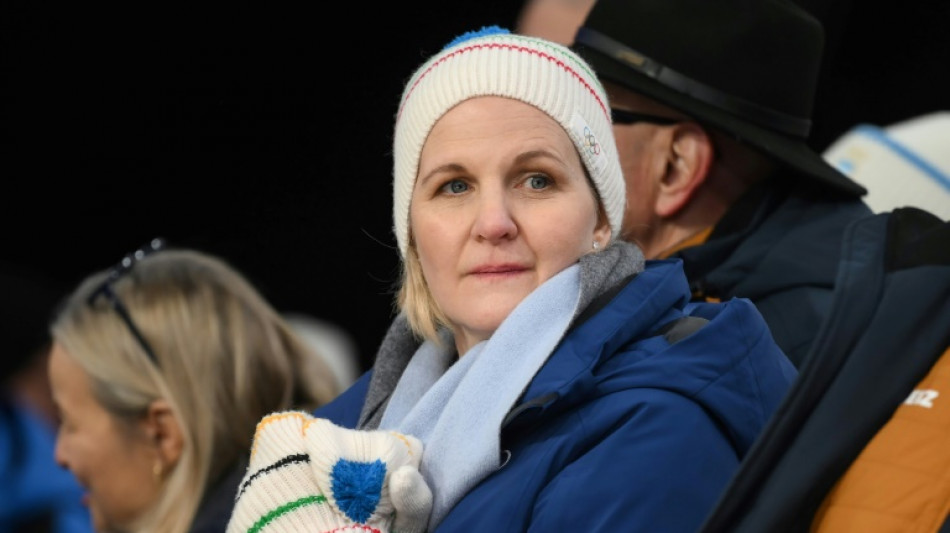
Coventry 'let the Games do their magic': former IOC executives / Photo: Marco BERTORELLO - AFP

Kirsty Coventry has had a successful first Olympics as president of the International Olympic Committee (IOC) because she let "the Games do their magic", two former IOC executives said on Sunday.
Terrence Burns, a former marketing chief at the IOC, told AFP that Coventry, who last March became both the first woman and African to be elected to perhaps the biggest job in sport, showed a sure touch in overseeing the Milan-Cortina Winter Olympics that close on Sunday.
"I think the best thing an IOC president can do at the Games is minimize their exposure, so the world focuses on the athletes," said Burns.
"The good ones don't make it 'about them' and so I think president Coventry has been great at letting the Games do their magic."
Michael Payne, who was credited with overhauling the IOC's brand and finances in two decades as marketing supremo, said Coventry could feel a sense of satisfaction as her first priority had been "a delivery of a great Games" and "everything went really well".
However, Payne warned that Coventry could not afford to be lulled into a false sense of security "because there are still major challenges ahead".
The one time the 42-year-old Zimbabwean did take centre stage in Italy was when the two-time Olympic swimming champion tried in vain to persuade Ukrainian skeleton racer Vladyslav Heraskevych to not wear a helmet adorned with pictures of Ukraine's war dead.
He had worn it in training runs but gestures of a political nature during competition are forbidden under the Olympic charter.
Despite her personal intervention Heraskevych refused and was disqualified.
"It was an excellent move for Coventry to speak to the athlete one on one, which showed genuine empathy," Payne told AFP.
"It wasn't just a perception of the 'official suit' and you can only compliment her on the human touch.
"She was genuinely emotional about it, she understood what it meant to an athlete if you take away the right to compete."
- 'Challenges on horizon' -
Payne, whose self-deprecatory warts-and-all book on his time at the IOC under Juan Antonio Samaranch Senior caused a stir last year, said Coventry had "handled a real baptism of fire correctly".
"This was a red line that if the IOC had conceded, it might have avoided a public relations backlash today but would have stirred up a hornets' nest for tomorrow."
For Burns, the former Zimbabwean sports minister brings a different style to that of her predecessor, the German Thomas Bach.
"She's a different generation from a different continent with a different perspective and is comfortable with English-speaking media.
"If you think about it, the first Games she will preside over that was chosen in her presidency will be the 2036 Games.
"That's ten years from now. So, I say, give her time to develop her own style."
Before that though, there are major challenges on the horizon.
Payne said one is the "growing weaponisation of sport".
"For a 30-year period sport had a pretty comfortable ride, then the last few years, back it came and sport got caught up in the forefront of political issues of the day," the 67-year-old Irishman said.
"Now we have the countdown to the 2028 Los Angeles Games where every politician will jump up on their soapbox and won't make it easy."
The second challenge is financial.
Reports claim revenue from the Olympic Partner Programme (TOP) -- granting exclusive, global marketing rights to the Olympics and Paralympics to a select group of companies -- has slumped.
"The thing about selling sponsorships, or anything really, is that buyers only buy what they need, which is not always necessarily what the seller is selling," Burns said.
"Listening and adapting to the needs of the modern marketplace will be key for the next iteration of TOP. And I am confident that will happen."
Overall, though, both Payne and Burns are optimistic about the future -- with caveats.
"The Games and Olympic brand are in robust health," said Payne.
But sport being increasingly used for political means "and the changing business dynamic -– marketing, how fans consume -- will require visionary leadership and skills to take the movement forward and manage the challenges, especially the political ones."
J.Hill--PI