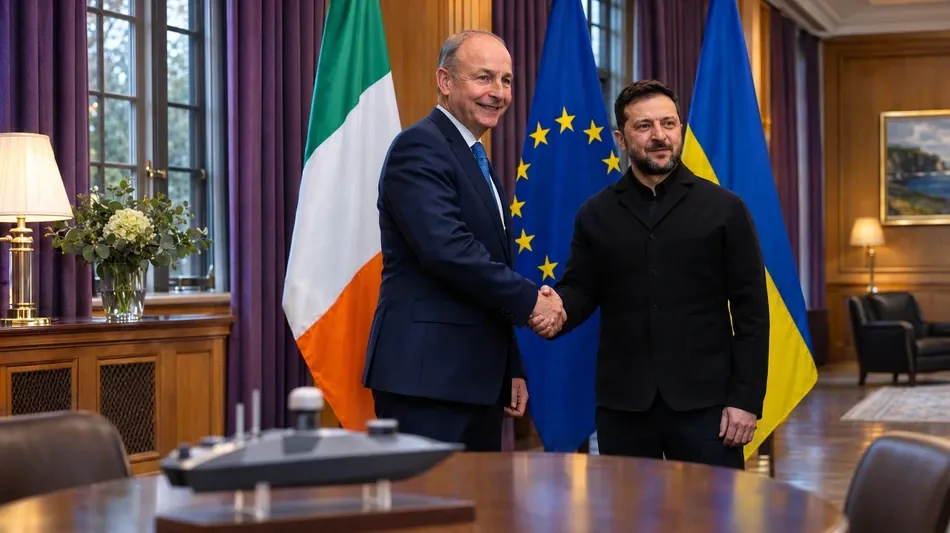
Ireland and Ukraine consider drone cooperation memorandum after Dublin talks

Ireland and Ukraine exploring joint memorandum on drones following bilateral Ireland and Ukraine are exploring forming a joint memorandum on drones, the Taoiseach said following a bilateral meeting with the Ukrainian President.
Ireland and Ukraine exploring joint memorandum on drones following bilateral Ireland and Ukraine are exploring forming a joint memorandum on drones, the Taoiseach said following a bilateral meeting with the Ukrainian President.
Ukrainian President Volodymyr Zelenskyy landed in Dublin on Wednesday ahead of the European Political Community summit in the Convention Centre. Security was tight at Government Buildings as he arrived for a meeting with Taoiseach Micheal Martin just after 5pm.
The leaders discussed the peace talks being mediated by the US, the need for a European representative to be picked urgently, Ukrainians living in Ireland and Ukraine’s EU accession. They spoke for about an hour, in what is President Zelenskyy’s third trip to Ireland in the last 12 months.
The Taoiseach said a joint memorandum on drones is being explored between the two countries, adding: "Given Ukrainian expertise in drone technology, we could avail of that technology, particularly unmanned drones in respect of maritime security." "But that work is still ongoing, and there was engagement between the two departments."
The Ukrainian President will be meeting US envoys Jared Kushner and Steve Witkoff in Dublin on Thursday. A second day of talks between Ukraine and Russia, mediated by the US, took place in Abu Dhabi on Wednesday, with President Zelenskyy saying he is "happy" with a change of approach.
Mr Kushner, US President Donald Trump’s son-in-law, and Mr Witkoff, are travelling to Moscow to meet Russian President Vladimir Putin this morning before meeting President Zelenskyy in Dublin later on Thursday. The Taoiseach said Ireland is facilitating this meeting on the sidelines of the EU summit.
When asked if he would like to be involved in these discussions, Mr Martin said: "Europe separately will have discussions in terms of who ultimately represents Europe in talks and in future talks, but obviously we will provide whatever support required to tomorrow's talks." President Zelenskyy has been calling for Europe to quickly pick a representative for peace negotiations, saying this must be done this month.
He said talks in Dublin will facilitate discussions on the finer details of the peace talks with the US envoys, but a "positive result" may have been achieved in exchanging over 1000 prisoners. The Ukrainian President said: "That would be a very positive thing, and I don’t see any reasons for Russia to not accept that proposal."
"A second thing that was discussed was security guarantees. Several formats of security guarantees for Ukraine were discussed." "It’s not the first time that this issue has been raised, but the sides have engaged in more detailed dialogue on this issue."
The EU recently extended its temporary protection directive for Ukrainian's until March 2028; however, it introduced stricter conditions. Since August, any new applicants must provide evidence that they left Ukraine after completing their military obligations.
Asked if he wants EU countries to send back those who haven’t completed their conscription for the military, President Zelenskyy said that’s a "very difficult question". He added: "Of course we want very much them to come back. But again, this is a difficult question because there are a lot of different circumstances of why people went away."
The Ukrainian President said many young men fled the war in the first days of attacks in 2022, but "then they came back" and it was "the right choice to come back" The Taoiseach said Ireland does not envisage pursuing people in this context.
He continued: "I don't think that's a dynamic we've ever been asked to engage in because I think Ukraine has a lot going on right now in terms of war itself." "I remember those days, those early days when we all remember our television screens were full of women and children on trains."
"The vast majority were women and children, and still in Ireland we have very substantial numbers of women and children as well who had to flee war."
R.Campbell--PI