Ordinary day, extraordinary times: Kyiv under Russian attack / Photo: Tetiana DZHAFAROVA - AFP

The air alert ends at 8:15 am with an explosion in the distance, allowing Anastasiia Zhmutska to finally take her 14-year-old son Orest to school in Ukraine's capital, Kyiv.
Anastasiia, 44, is a busy mother with three children, a job at a hospital and little time for herself. Since the end of summer, Russia has "added a few extra tasks", she says with a mischievous glint that barely conceals her fatigue.
Air alerts and explosions shatter her nights and set the rhythm of her days, as Russia steps up drone attacks that have killed more than 190 people in Kyiv since January.
Whether it's the school run or keeping an eye on Orest's 19-year-old brother, her timetable is organised depending on the risk of strikes.
The previous evening, she took her five-year-old daughter to safety at a second home with her father, far away from the attacks.
At school, she looks into her bag containing two battery power packs that she will recharge at work, where the electricity supply is uninterrupted.
After supermarkets and petrol stations, Russia is now attacking the power network, which has led to outages.
"It's becoming more complicated," Anastasiia tells AFP. "But it still has to be dealt with."
When the power comes back on in her flat, she quickly runs to put on a load of washing. For everything else, she uses a string of Christmas lights for illumination.
"There's always a way out of any everyday situation," she adds. "At the very least, I've managed to find a way out over the past five years."
- Sleepless nights -
Anastasiia drops Orest at school with a peck on the cheek and heads to the hospital. Orest lowers his gaze under a lock of blond hair as he settles at his desk -- alone.
The classroom gradually fills with a succession of tired faces after another sleepless night.
Literature teacher Nadia Sherekhor admits that Russian attacks have affected the quality of lessons. "Kyiv doesn't sleep," she says.
At 9:00 am, a minute's silence is held in memory of those who have died since 2022. The children stand with their hands on their hearts as the Ukrainian national anthem plays over loudspeakers.
The lesson resumes. Stretching sessions help the children cope with anxiety.
At 10:44 am, Russian drones are detected approaching Kyiv and the air alarm sounds.
Laughing and shouting, the children cross the courtyard and disappear into an underground space stretching beneath the school.
Everyone finds the corner of a table for their English and maths exercise books in the cramped corridor.
Orest is used to bomb shelters and explosions but in recent months he has become more anxious. "I keep everything to myself," he says.
Above ground, a drone's engine screams over the school, anti-aircraft fire crackles and a man looks up at the skies. The drone disappears and a detonation echoes in the distance.
- Breaking point -
At the hospital, Anastasiia chats with her colleagues about which canned goods to buy and how much water to stockpile.
"I'm always thinking about how to organise myself because for me the hardest part is making decisions," she says. "I carry this burden of responsibility all the time."
Anastasiia keeps an eye on her telephone, switching between school WhatsApp groups, Telegram channels monitoring Russian drones and Orest's GPS tracker.
At 2:00 pm, the teenager leaves school for gymnastics training before the power cuts paralyse public transport. He dreams of becoming an Olympic athlete.
"Before I answer him, I've already monitored everything: I've looked to see whether the route has changed, whether the metro has been shut down," she says.
Anastasiia's heightened state of alertness went to another level on October 14 when a Russian drone hit a business centre between her school and home.
A student who was waiting for his bus was severely wounded.
Fragments from the explosion fell onto Anastasiia's apartment building.
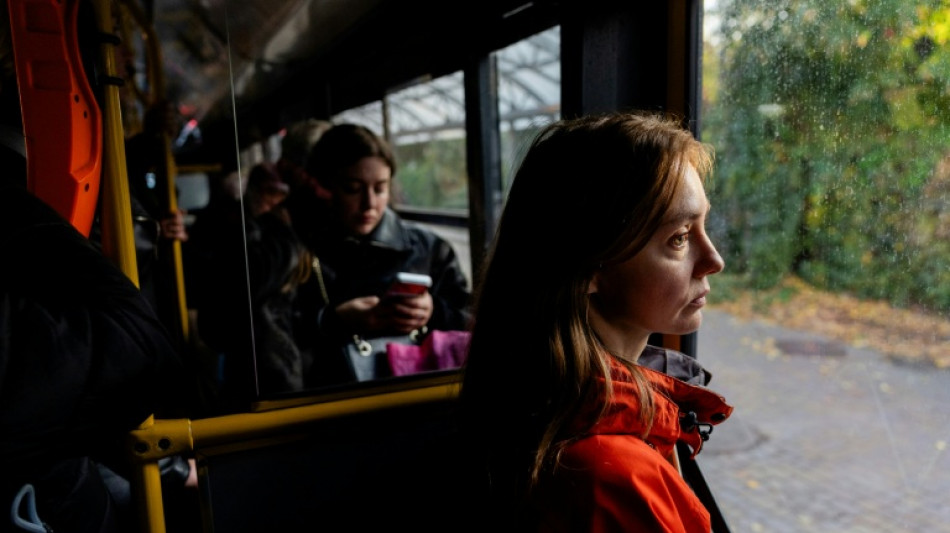
At 6:00 pm, she is on the bus and the family is heading to their second home on the other side of the Dnipro river that cuts through Kyiv.
"It's a peaceful place," she says. "But getting there is an ordeal."
Traffic jams build up at the approach to the Southern Bridge, which has been closed since Russian drones slammed into it the previous week.
At rush hour, the traffic is chaotic and it takes Anastasiia two hours to travel 15 kilometres (nearly 10 miles).
"It feels like it can't get any harder than it is right now but I know it will," she says.
She sends a last message before her phone switches off, asking her daughter to wait for her before she goes to sleep. A promised treat is in her bag.
Asked what is her breaking point for leaving Kyiv, Anastasiia is quiet for several seconds.
"I've already asked myself this question several times," she says finally. "And I don't know the answer."
C.Turner--PI