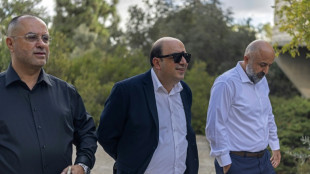
Israel courts Europe's far right, finding friends but also unease / Photo: Jack GUEZ - AFP

Facing growing isolation over the war in Gaza, Israel is increasingly allying itself with Europe's far right, despite some parties' legacies of antisemitism.
Prime Minister Benjamin Netanyahu has accused foreign critics of Israel's conduct in Gaza of fanning hate against Jews, but his government has mostly been comfortable with politicians so long as they support Israel.
After a French investigative site on Monday alleged that far-right National Rally leader Jordan Bardella made derogatory remarks about Jews as a teenager, Netanyahu's minister in charge of combatting antisemitism defended him.
Amichai Chikli said that Bardella, who could become prime minister if frontrunner Marine Le Pen wins next year's presidential election, "is one of the clearest voices in Europe against Hamas".
He pointed to his meetings on a visit to Israel last year with survivors of Hamas's October 7, 2023 attack, the deadliest ever against Israel which responded with its massive military campaign in Gaza.
In 2000, Israel recalled its ambassador to Austria and backed an international shaming campaign after the formation of a government that included the Freedom Party, founded by former Nazis.
But Netanyahu's government has moved to normalise ties with the Freedom Party.
Chikli in September hailed a "historic turning point" after Freedom Party leader Herbert Kickl delivered a speech vowing that if in power, his government's program would include "combatting antisemitism and fighting against anti-Zionism".
- 'Kosher certificate' for far right -
Israel has also courted other far-right leaders in Europe, including in Sweden, Spain and Britain, with Israeli politicians bonding over shared concerns about Muslim migration to the West.
Farther afield, Israel has hailed as a watershed its relations in Latin America after the election of hard-right, pro-Israel presidents in Argentina and Colombia.
One bridge too far, at least for now, is Germany, with Israeli officials still shunning the far-right AfD.
Jeremy Issacharoff, Israel's ambassador in Berlin from 2017 to 2022, as the AfD was emerging, said that some European far-right parties were looking for ways to show they have evolved from past antisemitism.
By building relations with Israel, "they get a sort of kosher certificate," Issacharoff told AFP.
"I can see what they get out of it; for Israel I only see damage to its values and its international standing," he said.
"Over the past three years, when you see greater criticism of Israel from the centre and the left, that creates a motivation from Israel's right-wing politicians to counterbalance that by appearing to have some elements in common," he added.
Issacharoff said that in Germany, but also in other European countries including France and Austria, Israel should first consider how supporting the far right would impact local Jewish communities.
In Britain, Jewish groups voiced alarm after Israel last year welcomed far-right provocateur Tommy Robinson and hailed his views on radical Islam.
- Seeing benefit in divisions -
Israeli officials have used strikingly undiplomatic language about Western leaders who criticise Israel.
Israeli Foreign Minister Gideon Saar recently called the leader of Britain's hard-right Reform Party to hail his opposition to new UK sanctions on goods from Israeli settlements in the occupied West Bank.
Israel at the same time denounced British Foreign Secretary David Miliband, the son of Jewish refugees, with Chikli even mocking his hairstyle.
Azriel Bermant, an associate researcher at the Institute of International Relations Prague who has studied Israel's relations with Europe, said that Netanyahu's embrace of the far right was also about driving wedges within Europe.
"As far as Netanyahu sees it, any countries that can support Israel and go against the European consensus, so much the better as far as he's concerned," Bermant said.
He pointed to Netanyahu's relationship with Viktor Orban, Hungary's leader until he lost elections this year.
Orban backed Israel even while critics said his campaign against George Soros, the billionaire philanthropist, tapped into antisemitic tropes.
Bermant expected Israel's approach to shift if Netanyahu loses power in October 27 elections, with his rivals still likely to reach out to leaders such as Le Pen who have a chance of taking office, but not identifying Israel with the far right.
One former Israeli ambassador in Europe, who asked for anonymity to preserve relationships, said he understood why Israel would not denounce Bardella, considering the possibility he and Le Pen will be leading France next year.
But he said Israel also needed to be more pragmatic by not rushing to align itself with divisive figures.
"One day governments will change from right to left, from left to right, and if you glue yourselves to the radical right, then you paint yourself with a certain colour," he said.
S.Scott--PI