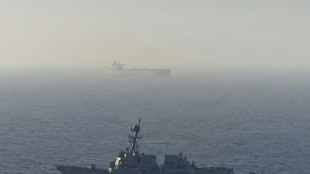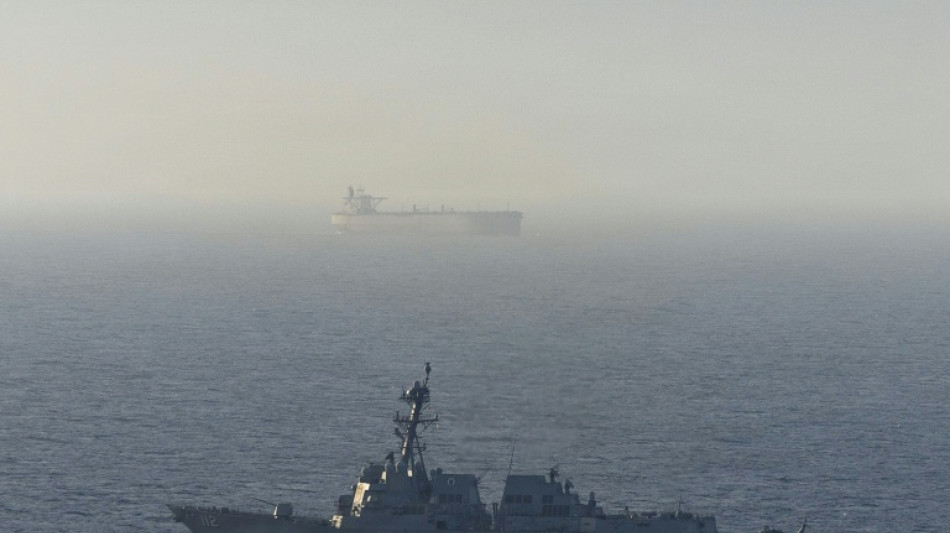
US military strikes oil tankers as Iran vows tougher reprisals / Photo: - - NAVCENT PUBLIC AFFAIRS/AFP

The United States said it destroyed three Iranian oil tankers on Saturday in response to attempted missile attacks on naval vessels, prompting Iran's military to warn of tougher reprisals if the strikes continued.
The latest round of clashes, which began with US raids last week, comes with both sides deadlocked in the six-month war as Iran maintains its stranglehold on the Strait of Hormuz and Washington presses its counter-blockade of Iranian ports.
In addition to the renewed military action, Washington is seeking to choke Iran's economy, announcing sanctions on entities with financial links to the Islamic republic in a bid to further isolate it and force it into submission.
US Central Command (CENTCOM) said it targeted tankers linked to the Islamic Revolutionary Guard Corps (IRGC), accusing the most powerful arm of the Iranian military of unsuccessfully firing at American warships.
"Following Iran's failed attacks, CENTCOM permanently disabled the IRGC crude oil carriers M/T Downy off the coast of Kharg Island and M/T Stark 1 near Jask," it said in a statement.
"American forces also completely destroyed the unladen crude oil carrier M/T Kylo... in the Gulf of Oman, striking the vessel in multiple critical locations to render it inoperable after the crew was directed to abandon ship."
Video posted by CENTCOM showed large fireballs and billowing flames after projectiles slammed into the ships.
The three vessels were "part of a multibillion-dollar shadow network that funds the IRGC and its regional proxies," it said.
After the strikes, CENTCOM commander Admiral Brad Cooper said: "If you shoot at two of our ships, we will impose an even higher economic cost -- taking out three of yours."
The Iranian foreign ministry hit out at Washington over the attack, saying it "strongly condemns the US aggressive action in attacking Iranian commercial vessels" and calling the strikes "illegal and aggressive actions" without providing further details.
A correspondent for Iranian state TV in Jask in the southern province of Hormozgan said one of the tankers was empty and the second was carrying oil. The crews were transported to shore on lifeboats, they said.
Another state TV correspondent on Kharg Island said the attack there caused no casualties.
Iran's Khatam-al Anbiya central military command warned that if the US continued its attacks, then Iranian retaliation against US warships would be "more severe than before, and there is a possibility of their expansion."
- 'Small potatoes' -
The Trump administration has been seeking to play down the significance of the six-month conflict, which has proven increasingly unpopular at home as midterm elections near.
US Vice President JD Vance went so far as to say that he "wouldn't call it a war," claiming that "right now, there is no active shooting" despite the ongoing exchanges of fire.
US President Donald Trump backed his comments on Friday, calling the Iran war "small potatoes" for the US and insisting: "It's not a big thing."
Iran's Security Chief Mohsen Rezaei warned this week that the Islamic republic had adopted a "new strategy" against Washington in the war that "will shatter your foundations."
The US has been trying to step up pressure on Tehran over its blockade of the Hormuz Strait, through which one-fifth of world oil supplies previously flowed.
A fragile ceasefire collapsed in July after attacks on commercial ships in the strategic waterway.
Trump has in recent weeks repeatedly threatened to claim sovereignty over the strait, even posting a map showing it as a "new US territory."
Vance has also insisted that the US would not reopen talks with Iran until it ended attacks on commercial shipping in the Hormuz.
But with fuel prices threatening to cost Trump's Republicans their control of Congress at the ballot box, his administration has begun pushing the message that oil flows through the waterway are now returning to prewar levels.
"Their control over the Strait of Hormuz is effectively gone," Vance said of Iran on Thursday.
Before the latest hostilities erupted, the United States had appeared to be pivoting to economic warfare rather than military operations.
On Friday, the Treasury announced sanctions on a Turkish bank over its alleged ties to Iran's Revolutionary Guards, and last week Washington took a step towards cutting off a major Egyptian bank's UAE operations from the US financial system.
Treasury Secretary Scott Bessent has laid out plans for the "economic asphyxiation" of Iran, warning of dire consequences for countries that do not join the American pressure campaign.
R.Walker--PI