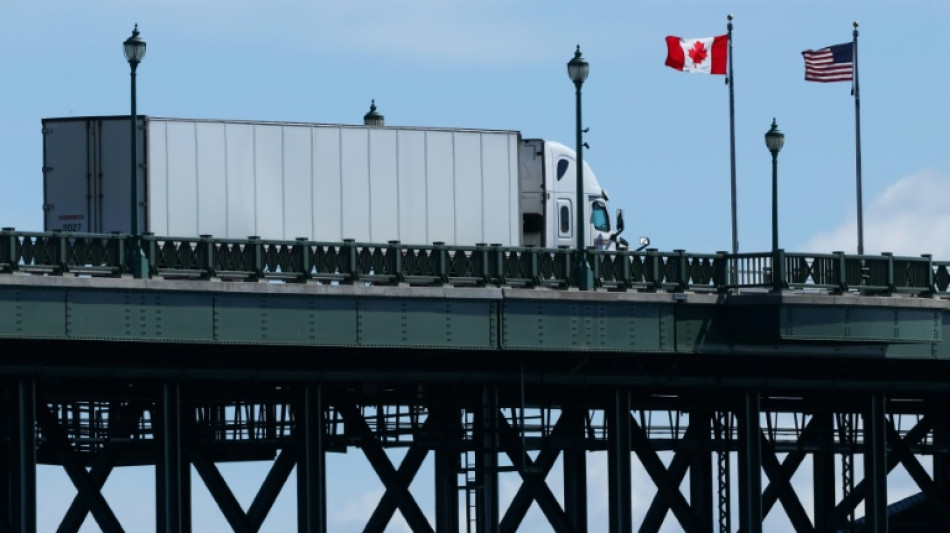
Trump tariffs heap up as Canada tries to curb US reliance / Photo: Cole BURSTON - AFP/File

US President Donald Trump's 50-percent tariffs on certain Canadian goods which took effect Saturday delivered another blow to bilateral trade, renewing focus on Ottawa's efforts to reduce dependence on its southern neighbor.
Canadian Prime Minister Mike Carney's strategy involves a search for new markets, a focus on domestic trade and the launch of major projects.
- Inter-connected markets -
The two economies are heavily inter-connected, with roughly 70 percent of all Canadian exports heading to the United States.
Previous Trump levies on autos, steel, aluminum and lumber have hit Canada hard, forcing job losses and stunting growth.
Canada has even entered a technical recession this year after two consecutive quarters of economic contraction.
The latest 50-percent tariffs came into force after days of negotiations failed to produce an agreement.
They impact some $20 billion worth of goods, or 5.5 percent of Canadian exports to the United States, targeting products ranging from hockey sticks to cement.
Carney said Friday that Canada would match the US tariffs "dollar for dollar to protect our workers and businesses."
- Breaching the shield -
The exports affected by the US tariffs include products that were previously protected under the North American trade pact, the United States-Mexico-Canada Agreement (USMCA).
At first glance, "that's frightening," said Richard Ouellet, a professor of international economic law at Quebec's Laval University.
"Until now, the USMCA acted as kind of a shield. The Americans are opening a breach," he told AFP.
Trump declined to renew the USMCA on July 1, making it subject to annual reviews.
While Trump ditching USMCA exemptions could forecast more extreme measures to come, Canada's largest bank, RBC, predicted the first package of 50-percent tariffs won't "significantly change broader Canadian growth."
"That's because the new tariffs, while significant, will still impact a small segment of total trade," RBC said last month, adding that around 80 percent of Canadian goods would still enter the United States tariff-free.
- 'Diversification' -
Since taking office in March 2025, Carney has focused on diversifying economic partnerships to reduce Canada's reliance on the US market.
"Canada has what the world wants," Carney said in a statement following the breakdown of negotiations with Washington.
"We will not allow any nation to determine our future," he said.
The prime minister has headed to China, India and Saudi Arabia and made several stops in Europe seeking deals to expand Canada's economic relationships overseas.
In January, he signed a preliminary agreement with China, providing for the import of electric vehicles to Canada.
Relations with Europe have also been strengthened. In July, Canada selected the German firm TKMS to build its new fleet of submarines.
Last month, Canada's central bank said the economy was "showing signs of improving," noting that some businesses were adjusting to US protectionism, including by finding new customers abroad.
A report from Canada's international trade minister also said that in 2025 the value of exports to non-US markets jumped by 11 percent, hitting 33 percent at one point -- the highest level in more than four decades.
- Domestic revitalization -
Another factor that could help cushion the impact of Trump's tariffs is a renewed focus on domestic trade.
One of Carney's first major initiatives as prime minister was federal legislation to reduce interprovincial trade barriers.
Provinces have shown reluctance to lift their own restrictions, but Ouellet said that overall "the Canadian market has been reinvigorated and there is more domestic trade."
Carney has also tried to jumpstart domestic economic activity through his Major Projects Office, set up to reduce bureaucratic delays and grant quicker approval for select large-scale infrastructure initiatives.
Carney has promised port expansion in Montreal and Vancouver and new mines to exploit critical minerals, as well as backing plans for an oil pipeline from Alberta to the Pacific.
Overall, Ottawa has unveiled plans to spend CAN$115 billion ($83 billion) on infrastructure and an unprecedented CAN$82 billion on defense over the coming years.
J.Collins--PI