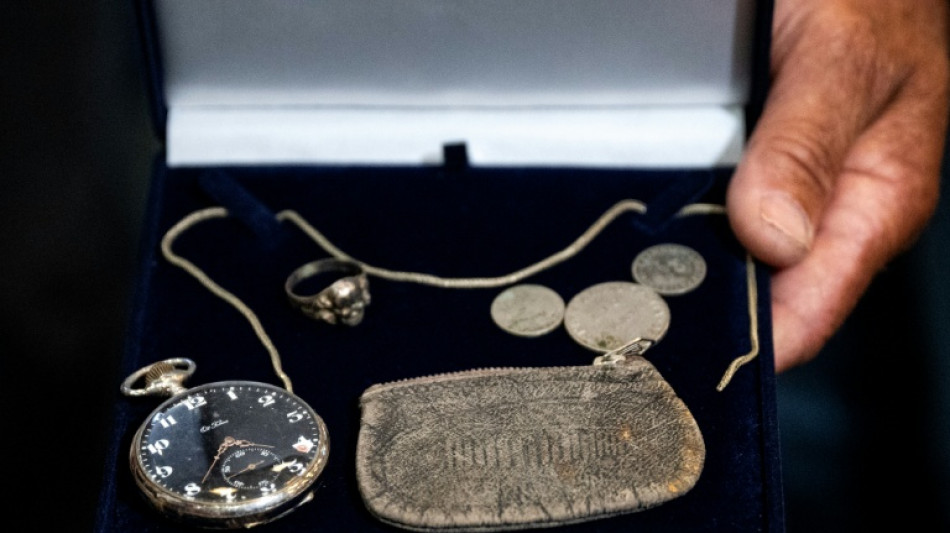
Greek families receive keepsakes of Holocaust victims / Photo: Angelos TZORTZINIS - AFP

A watch, a wallet, a ring: personal effects taken from Greek prisoners at a German concentration camp were returned to their descendants on Thursday, 81 years after the Holocaust.
Kaiti Kerasiotis's eyes filled with tears as she held in her hands the watch of her husband Evangelos after an emotional ceremony at the Greek foreign ministry.
He was deported in May 1944, aged just 19, to the Neuengamme concentration camp near Hamburg. Decades later, Greek school pupils taking part in a historical memory campaign found his elderly surviving spouse.
"I can't believe it," she murmured, speaking to reporters, surrounded by her children and grandchildren, as she recalled the evening she was contacted by the pupils.
"I took out the photos I had put away. I went back into the past and I told myself he had not been forgotten after all."
- 'Participatory remembrance' -
The restitutions in Athens were part of the #StolenMemory campaign launched in 2016 by the Arolsen Archives -- the world's most comprehensive records on victims and survivors of Nazi camps.
Greek pupils were tasked with tracing the families of prisoners deported between 1943 and 1944, in a project with the Greek foreign and education ministries.
"As camp survivors become ever fewer, new, more participatory forms of remembrance must be developed," said the Arolsen Archives' director, Moritz Wein.
Interest in such personal stories shows no sign of waning, Wein added. Requests from families seeking traces of relatives deported to Nazi camps have surged over the past two years.
"The role of archives in the age of artificial intelligence and the distortion of history is all the more important."
- Lost uncle's watch -
Secondary school pupils in Evosmos, near the northern city of Thessaloniki, which once had a large Jewish community, spent months searching municipal archives, police records and Greek Red Cross files to trace Evangelos Kerasiotis's family.
From Neuengamme, Evangelos was transferred to the Salzgitter-Druette labour camp and then to Bergen-Belsen, where British forces recorded his presence after the liberation.
He returned to Greece in August 1945 and joined the police, but died aged just 24 from a heart condition linked to his ordeal in the camps.
Nearly 70,000 people -- 86 percent of Greece's Jewish community -- were killed during the Nazi occupation of Greece from 1940 to 1944.
Today the community numbers around 5,500.
Panagiota Galani recovered a watch that belonged to her uncle, Georgios Sagmatopoulos, who was deported to Germany at 24.
Her mother and grandmother had searched for him for years and only received confirmation of his death in 1962.
"We have always lived with the shadow of this uncle who never came back," she said. "My grandmother would have been very moved to see this watch again."
- 'Dehumanised' -
To find the descendants of Nikolaos Fassouliotis, a Cypriot living in Greece who was deported in 1944, pupils in Athens sent dozens of emails and made numerous phone calls before locating one of his daughters in Cyprus.
The former deportee, who died in 2000, had rebuilt his life and had six children on the island.
Konstantina received her father's bracelet, engraved with the names of his two children from a first marriage.
"I hope one day to find traces of my father's family," she said, her voice breaking.
Wein handed her a bag filled with documents that belonged to her father: camp registration papers, notes on forced labour and more.
"These men were stripped of their belongings on arrival at the camps, dehumanised by the Nazis," Wein said.
"Today, by returning these objects to their families, we are restoring part of their identity."
The Arolsen Archives still hold 2,000 envelopes containing the personal effects of deportees from several countries that have yet to be returned.
C.Carter--PI