Colombia in mourning after deadliest attack in decades / Photo: JOAQUIN SARMIENTO - AFP

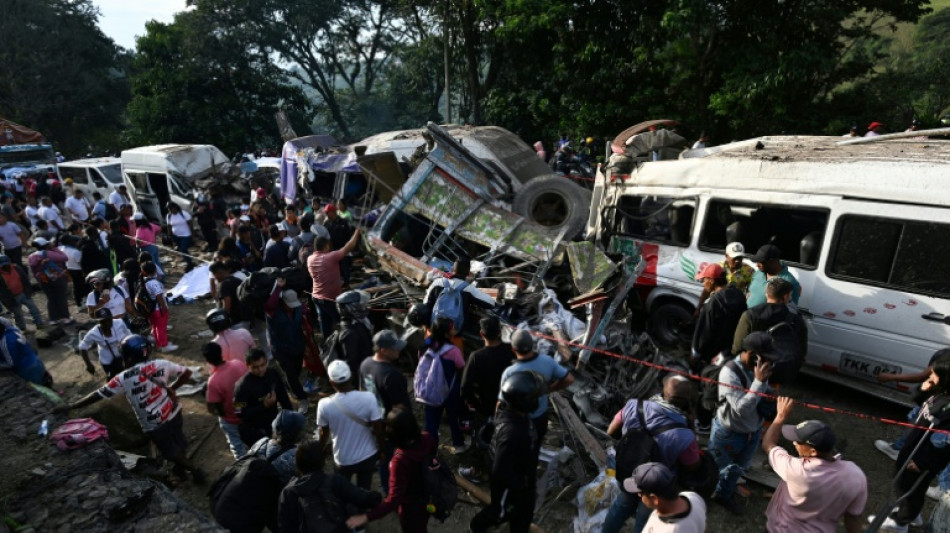
Colombia on Monday was in mourning for the 21 victims of the country's deadliest bomb attack on civilians in decades, coming in the run-up to key elections.
Saturday's bomb attack on a highway in southwestern Cauca department comes amid a sharp uptick in violence ahead of May 31 presidential elections.
It was the biggest single loss of life since the now-defunct rebel army FARC blew up a Bogota nightclub in 2003, killing 36 people.
AFP journalists saw dismembered bodies and a dozen wrecked vehicles next to a massive crater in the middle of the road, in scenes reminiscent of the darkest days of Colombia's armed conflict in the 1980s.
The government of left-wing President Gustavo Petro has blamed a group of cocaine-smuggling guerrillas, with whom the state briefly held peace talks, for the attack.
The group, Central General Command, known by its Spanish acronym EMC, is led by Ivan Mordisco, Colombia's most-wanted criminal.
A dozen of the victims were from a village near the town of Cajibio, where hundreds of mourners held a vigil on Monday.
The mourners were dressed in white and waved white sheets or balloons as a sign of peace.
"Please, no more death, no more violence," said Joao Valencia, 42, a relative of a woman killed in the attack, told AFP, holding up her picture.
"These kinds of women should die of old age, not have their lives taken from them in such a tragic way," he added.
Insecurity is one of the top themes in the race to pick a successor to Petro, who is barred by the constitution from seeking a second consecutive term.
At least 31 guerrilla attacks were recorded in southwest Colombia since Friday, a military spokesman told AFP.
Defense Minister Pedro Sanchez said the guerrillas were lashing out due to intense pressure from the military in recent months.
"Terrorism, when employed in this way...is because the pressure is so intense...that the only option is to attack the most defenseless," Sanchez told Blu Radio.
- Coca-growing region -
The onslaught continued on Monday.
In Jamundi, a municipality in Valle del Cauca department, soldiers found a burned-out truck loaded with charred chickens, an AFP reporter confirmed.
During the early morning hours, in a separate part of Cauca, a pickup truck packed with explosives detonated but caused no casualties, according to local media.
Cauca is one of the main areas for the cultivation of coca, a key ingredient in cocaine, the main revenue spinner for Colombia's guerrillas.
Laura Bonilla, deputy director of the Peace and Reconciliation Foundation, said the attacks were an attempt by the EMC to gain leverage in negotiations with local communities.
Under that scenario, she said, the guerrillas would "reduce levels of violence in exchange for fewer police operations" and drug seizures.
- 'Climate of fear' -
Petro, Colombia's first-ever left-wing leader, came to power promising to pursue "total peace" by launching talks with all the armed factions that stayed out of a landmark 2016 peace deal with FARC.
But the peace process backfired.
Analysts say the guerrillas used ceasefires to regroup and expand the areas under their control.
The number of fighters doubled in 10 years to 27,000 combatants, Gerson Arias, a researcher at the Ideas for Peace Foundation, estimated.
Right-wing candidates have vowed to crack down hard.
"This government has allowed violence to grow," right-wing candidate Paloma Valencia, a native of Cauca, charged.
The election frontrunner, left-wing senator Ivan Cepeda, said Saturday's attack favored the far-right by seeking to "generate a climate of fear."
The campaign has so far been marked by several acts of political violence.
Last year, a young conservative candidate, Miguel Uribe Turbay, was shot in broad daylight while campaigning at a park in Bogota.
He died two months later.
In February, Cepeda's Indigenous running mate, Senator Aida Quilcue, was abducted for several hours by armed men in Cauca.
J.Hill--PI