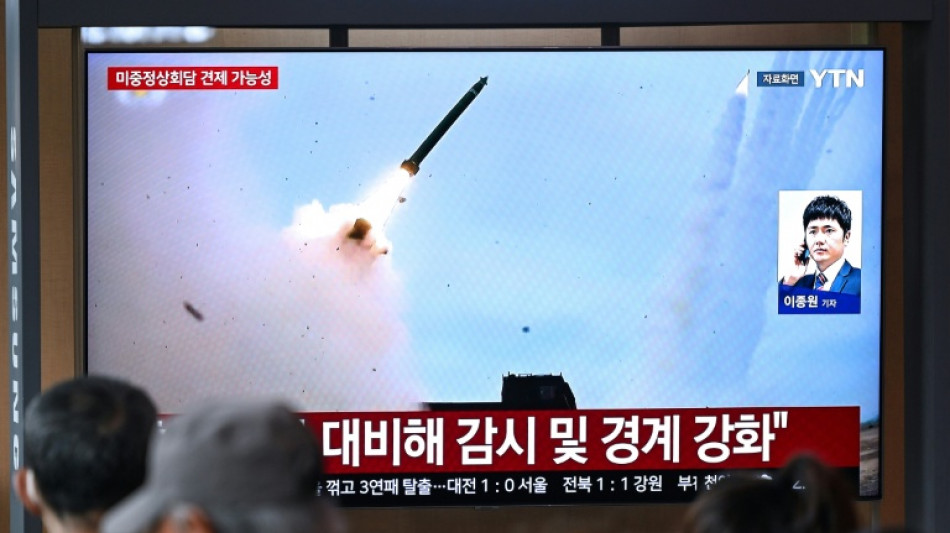
North Korea strengthens nuclear push as US flails in Middle East / Photo: Jung Yeon-je - AFP

North Korea is taking advantage of the Middle East war to speed up its weapons development and cement its nuclear status in a world where international norms have broken down, analysts say.
Since US-Israeli strikes on Iran began in late February, North Korea has conducted five missile launches, including four so far in April -- the most in a single month since January 2024, according to an AFP tally.
They follow a pledge by leader Kim Jong Un to bolster nuclear forces, as Pyongyang reaps the benefits of deeper ties with Russia and sharpens its invective against US ally South Korea.
The launches "appear to be part of a sophisticated strategy" to balance military upgrades against shifting dynamics between the United States, Russia and China, said Lim Eul-chul, a North Korea expert at the South's Kyungnam University.
"The current global security landscape has transformed into a 'lawless zone' where existing international norms no longer function," he said.
"North Korea is exploiting this vacuum... to complete its nuclear arsenal."
Pyongyang has condemned US attacks on Iran as "gangster-like", but is not thought to have supplied arms to Tehran and has notably refrained from directly criticising President Donald Trump, who is expected to visit China for a summit next month.
There has been speculation that Trump may meet Kim around that time.
"With the summit likely to draw attention to the North Korea agenda, Pyongyang may have seized the moment to reinforce its message that it is an irreversible nuclear state," Hong Min, a senior research fellow at the Korea Institute for National Unification, told AFP.
However, it also wants to send "a continuous signal that it possesses a fundamentally different deterrent posture from Iran's".
- Nuclear options -
The flurry of missile launches began soon after the Workers' Party congress in February, a once-in-five-years event that directs state efforts.
The timing suggests that North Korea wants to "front-load visible achievements" in its weapons capabilities, Hong said.
At that congress, Kim said North Korea's "position as a nuclear weapons state has been consolidated to be irreversible and permanent".
The launches have involved sanctioned ballistic missiles, anti-warship cruise missiles and cluster munitions.
Analysts told AFP the manoeuvres displayed certain technical advancements and growing proficiency with dual-use weapons, designed for both nuclear and conventional roles.
They included evidence of North Korea's ability to mount miniaturised nuclear warheads and conduct "saturation attacks" that overwhelm enemy interception networks with sheer quantity, Lim said.
Pyongyang is likely to pursue "continuous" ballistic missile testing as it pivots from simple weapons development towards the "normalisation of nuclear operations", he said.
"The regime judges that while the US is tied down in the Middle East, it is the optimal time to accelerate offensive deterrence and the parallel development of nuclear and conventional forces."
- More bangs, more bucks -
The launches also show North Korea's willingness to flaunt its backing from Russia, which has given Pyongyang valuable economic and technical assistance in return for thousands of North Korean troops sent to help its invasion of Ukraine.
"This is an attempt to demonstrate that they have a powerful ally in Russia despite pressure from the US and China, effectively rendering sanctions obsolete," Lim said.
In recent high-level exchanges, Pyongyang and Moscow have celebrated the connection of their first road bridge, the start of construction of a "friendship hospital", and the inauguration of a North Korean military memorial complex.
Russia's defence, interior, natural resources and health ministers, as well as its parliamentary speaker, the head of its trade union federation and the chief of the TASS news agency, have all visited the diplomatically isolated nation.
Pyongyang's ambassador to Moscow reportedly even discussed agricultural cooperation with the Russian-installed leader of Kherson, in occupied Ukraine.
"North Korea is one of the few countries that would not be afraid to operate in occupied Ukraine, and both sides are making use of this," said Fyodor Tertitskiy, a Russian-born scholar at Seoul's Korea University who studies the North.
Cultural bonds have deepened too, with Russia hosting an exhibition of North Korean art glorifying the Ukraine war, and a North Korean restaurant operating in Moscow.
"There is no 'boom' or sharp increase, but there are always clients interested in this country," said Olga, the administrator of a Moscow travel agency that offers tours to North Korea for around $1,500.
But Tertitskiy said he doubted that the friendship would live long beyond the Ukraine war, saying it was "driven almost exclusively by the ongoing invasion".
"Putin needs ammunition; everything else is secondary."
J.Collins--PI