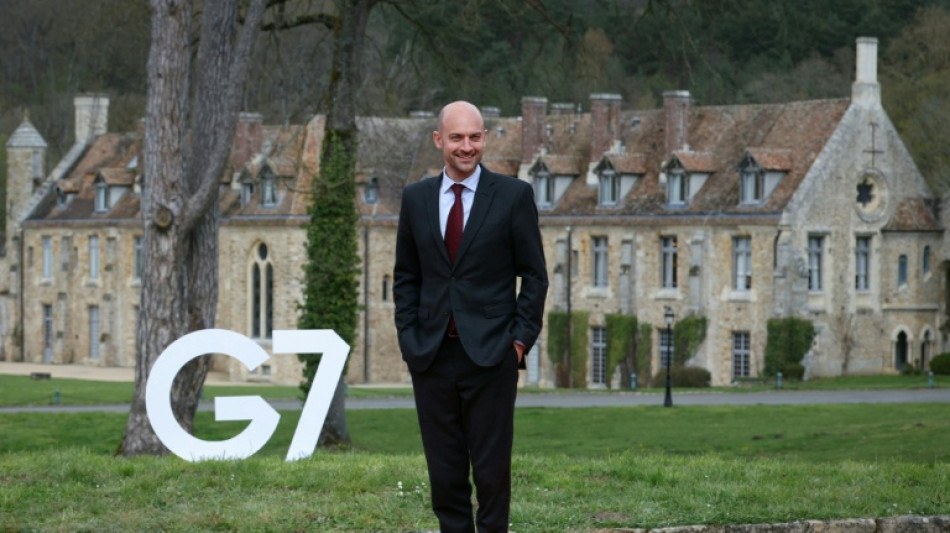
G7 meets in France hoping to heal transatlantic Iran rift / Photo: Alain JOCARD - AFP

European and allied nations on Thursday looked for ways to narrow differences with the United States on the Middle East war as a two-day meeting of G7 foreign ministers got underway outside Paris.
While President Donald Trump says Washington is pursuing diplomacy with Iran while threatening even more intense military action, American allies are hoping that the United States will set out its position clearly.
The start of the two-day meeting of seven leading industrialised democracies at the Vaux-de-Cernay Abbey outside Paris on Thursday was marked by the absence of US Secretary of State Marco Rubio.
He will join fellow top diplomats from Canada, Germany, Italy, France, Japan and the United Kingdom -- but only on Friday.
In contrast to usual protocol, and in a sign of the distance between the United States and its allies, there is to be no joint communique at the end of the meeting.
Instead, the G7 presidency, which France holds this year, will issue a statement, a diplomatic source said, asking not to be named.
"I am quite confident that we can define a common position," said German Foreign Minister Johann Wadephul before entering the meeting.
"The goal is to end this conflict as quickly as possible, but also sustainably."
He added it was of "great importance" for Germany to know "precisely what our American partners are intending", adding it would be encouraging if the US was holding "direct" talks with Iran.
- 'Can't overlook' Ukraine -
While all G7 nations are close US allies, none have unambiguously offered support for the assault on Iran, angering Trump.
Trump's threat to hit Iranian energy facilities -- now toned down amid the purported talks -- has troubled European allies, who have all called for de-escalation and are not engaged militarily in the conflict.
EU foreign policy chief Kaja Kallas said there was a "need to exit from the war, not escalate it further".
She also warned that more than four years into Russia's full-scale invasion of Ukraine, "attacks of Russia on Ukrainian civilian infrastructure are increasing every day and we can't overlook this".
Kallas also accused Moscow of sharing intelligence with Tehran that was used to target Americans in the Middle East.
"These wars are very much interlinked," she said.
The meeting got underway after a morning of bilateral talks with a session on reforming global government.
Sessions on Iran and Ukraine are set for Friday, according to the schedule.
French Foreign Minister Jean-Noel Barrot is due to hold a news conference later Thursday evening.
France would also host a separate G7 meeting via video call on Monday bringing together finance ministers, energy ministers and central bank governors, Finance Minister Roland Lescure told RTL radio.
The G7 should collectively back efforts to de-escalate the war, Canada's Foreign Minister Anita Anand told AFP, pointing to "problems in the global provisioning chain" due to the almost total closure of the Strait of Hormuz trade bottleneck.
"We must continue to use diplomatic channels to be sure there is a common view not just for a de-escalation but to mitigate the economic shock," said Anand.
J.Wilson--PI