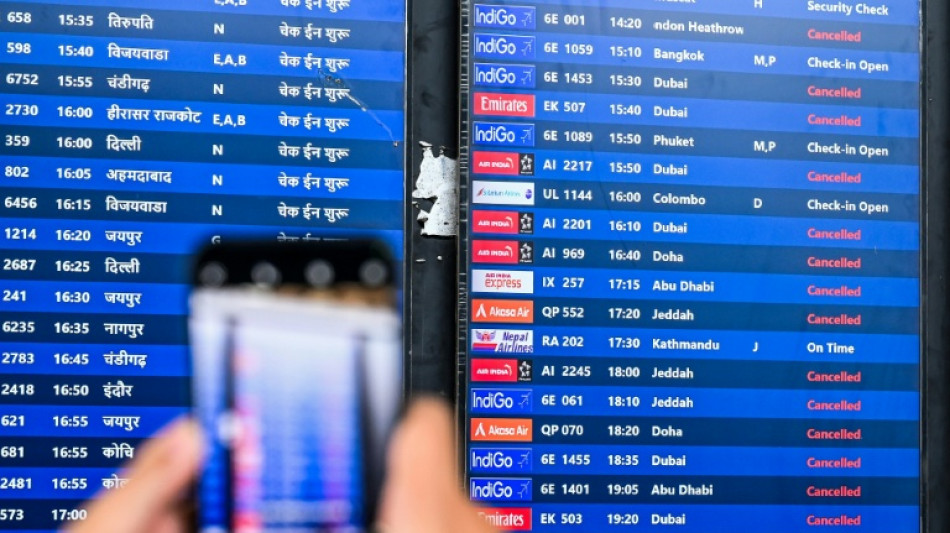
Flights to evacuate stranded travellers in Middle East / Photo: Punit PARANJPE - AFP

Evacuation flights are set to rescue tens of thousands of travellers stranded in the Middle East even as some airlines resumed on Tuesday a limited number of scheduled flights.
The situation remains dangerous in the region, with Qatar saying it had blocked Iranian attacks on its airport, one of the major hubs in the region.
The US and Israeli attacks on Iran which began on Saturday, followed by Iranian counterattacks on Gulf states and Israel, have led the closure of the airspace of a number of countries.
That has caused the cancellation of at least 12,903 flights between Saturday and Monday, according to Cirium, an aviation data analysis firm, or about 40 percent of planned flights.
Cirium estimates that the flights in the region account for around 900,000 seats per day, so the number of affected travellers could easily already be more than one million.
- Slow resumption -
On Sunday, nearly 100 percent of flights were cancelled out of the United Arab Emirates, home to the second-largest airport in the world in terms of passengers: Dubai's DXB.
That fell to 93.5 percent on Monday.
DXB and Abu Dhabi's airport resumed limited operations on Monday.
Several Emirates flights took off Tuesday morning, according to the Flightradar24 flight tracking website.
The aircraft immediately flew south to exit the Gulf region.
The vast majority of flights in and out of DXB remain cancelled.
Only some flights by flag carrier Emirates, low-cost flydubai and Russia's Aeroflot were operating.
Numerous Royal Jordanian flights took off and landed at Amman's airport, but flew via the south of the country to avoid Israeli airspace.
Flight continue in and out of Saudi Arabia and Oman, and their airspace is being used by numerous long-haul flights between Europe and Asia.
No civilian flights were circulating in the airspace above Iraq, Israel, Kuwait, Libya or Qatar, however.
- Evacuation flights planned -
Several countries have organised evacuation flights to repatriate their nationals.
Two evacuation flights with 200 passengers each landed in the Czech capital Prague on Tuesday morning.
"We are preparing to charter flights so that the most vulnerable people... can benefit," French Foreign Minister Jean-Noel Barrot.
He said some 400,000 French nationals were located in the dozen countries affected by the conflict.
Germany had announced on Monday it would send aircraft to Saudi Arabia and Oman as soon as possible to evacuate the most vulnerable travellers.
There are around 30,000 Germans stranded in the region, according to the German Tourism Association.
Travel firm TUI said Tuesday it would begin flying home 5,000 clients stranded on two of its cruise ships in the Gulf via Dubai.
Three Indian airlines -- IndiGo, Air India Express and Akasa Air -- announced a limited number of evacuation flights to the Middle East.
Three flights evacuating Italian nationals were expected to land in Rome and Milan later Tuesday, according to the airports.
British Foreign Secretary Yvette Cooper said Tuesday a UK government charter flight would bring home British nationals from Oman in the coming days.
British Airways said it had scheduled a flight from Oman on Thursday.
Foreign Minister Jose Manuel Albares said Spain was also organising evacuation flights, and an Etihad flight carrying Spanish nationals was set to land in Madrid on Tuesday evening.
- Suspended operations --
Numerous airlines are continuing to suspend their flights to the Middle East, at least for the coming days, including Air France, British Airways, LOT, Norwegian and SAS.
Finnair has halted flights to Doha and Dubai until nearly the end of the month.
K.Thompson--PI