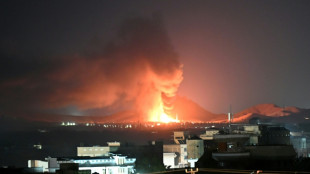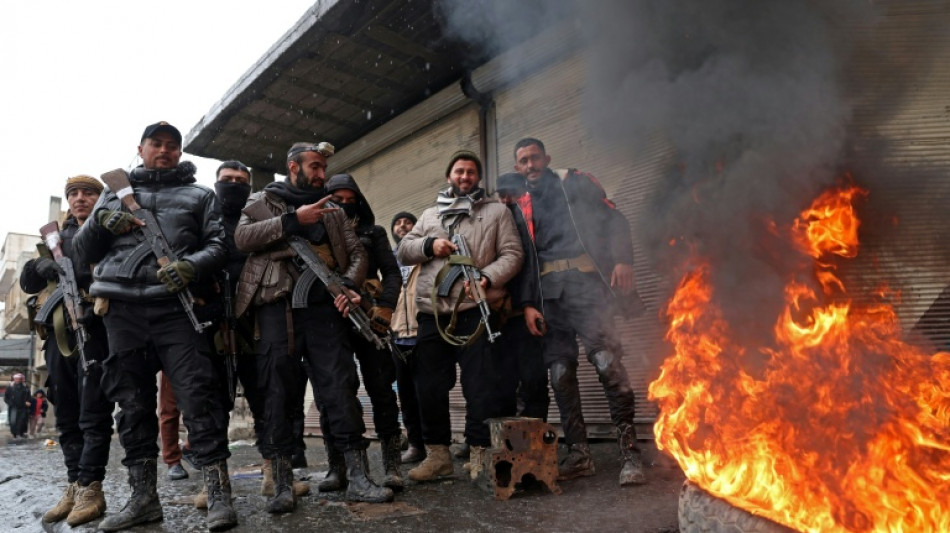
Kurdish forces withdraw from Syria's largest oil field as govt forces advance / Photo: OMAR HAJ KADOUR - AFP
Kurdish-led forces withdrew on Sunday from Syria's largest oil field, a conflict monitor said, as government troops extended their grip over swathes of territory in the country's north and east.
The push came after President Ahmed al-Sharaa issued a decree granting the Kurds official recognition in an apparent goodwill gesture, even as his Islamist government seeks to assert its authority across Syria after the ousting of longtime ruler Bashar al-Assad in 2024.
The Kurds' de facto autonomous administration, which controls large parts of the northeast, has said the announcement fell short, while the implementation of a deal to integrate Kurdish forces into the state has been stalled for months.
Early Sunday, the Kurdish-led Syrian Democratic Forces (SDF) suddenly withdrew "from all areas under its control in the eastern Deir Ezzor countryside, including the Al-Omar and Tanak oil fields", the head of the Syrian Observatory for Human Rights, Rami Abdel Rahman, told AFP.
He said the SDF withdrawal in Deir Ezzor and Raqa provinces came as "fighters from local tribes, including Arab fighters who are part of the SDF, advanced in coordination with government troops".
The areas are now effectively controlled by government forces, the Observatory said.
Al-Omar is the country's largest oil field, and was home to the United States' largest base in Syria. It had been controlled by Kurdish-led forces since 2017 after the Islamic State jihadist group was pushed out.
The Kurds' reported withdrawal from Al-Omar follows the government's announcement that it had retaken two other oil fields, Safyan and Al-Tharwa, in Raqa province.
- 'Opening the door' -
The government's push has so far captured Arab-majority areas that came under Kurdish control during the fight against IS, whose defeat in Syria was secured with the help of the US-backed SDF.
Energy Minister Mohammad al-Bashir said the return of the area's resources to state control "means opening the door wide for reconstruction, revitalising agriculture, energy and trade".
Government troops drove Kurdish forces from two Aleppo neighbourhoods following clashes last week, and on Saturday captured an area east of the city, as well as Tabqa, in Raqa province, on the southwestern banks of the Euphrates.
The army also announced its control of the Euphrates Dam, adjacent to Tabqa.
The key water and energy facility includes one of Syria's largest hydroelectric power stations.
A security source on the ground in Tabqa told AFP that security forces and the army were combing neighbourhoods after the SDF pullout.
An AFP correspondent saw armoured vehicles and tanks around the city, with security personnel patrolling the streets.
Intermittent gunfire could be heard from what one security officer said were limited clashes with the SDF.
Shops were closed, but some residents milled outside their homes, lighting fires to keep warm.
One resident, Ahmad Hussein, told AFP that people were afraid.
"We have suffered a lot, and I hope that the situation will improve with the arrival of the Syrian army," he said.
Near the dam, an AFP photographer saw residents destroying a statue honouring a woman who fought with Kurdish forces and who was killed by IS during the battle for Raqa city.
The city was the jihadists' main stronghold at the height of its reign across swathes of Syria from 2014 to 2019.
- 'Killing must stop' -
Syrian authorities accused the SDF of blowing up two key bridges across the Euphrates River in Raqa province.
The Kurdish administration accused government forces of attacking their fighters "on multiple fronts" while the army said the SDF was not fulfilling a commitment to "fully withdraw" east of the river.
The Deir Ezzor province said all public institutions were closed on Sunday and urged people to stay home.
The Kurdish forces' withdrawal came after US envoy Tom Barrack met Syrian Kurdish leader Mazloum Abdi in Erbil on Saturday, and the US Central Command urged government forces "to cease any offensive actions" between Aleppo and Tabqa.
The United States has long supported the Kurdish forces, but it has also backed Syria's new Islamist authorities.
Damascus ally Turkey has praised Syria's operation, but imprisoned PKK leader Abdullah Ocalan, "sees this situation (in Syria) as an attempt to sabotage" the unfolding peace process between his group and the Turkish state, a delegation said after visiting him on Saturday.
In Qamishli, the main Kurdish city in the country's northeast, hundreds of residents demonstrated on Sunday, an AFP correspondent said, chanting slogans including "we will defend our heroes".
Muhayeddine Hassan, 48, said that "we want a democracy that represents all Syrians".
If Sharaa "wants equality... the killing must stop", he said.
burs-lar/lg/jfx
J.Jackson--PI