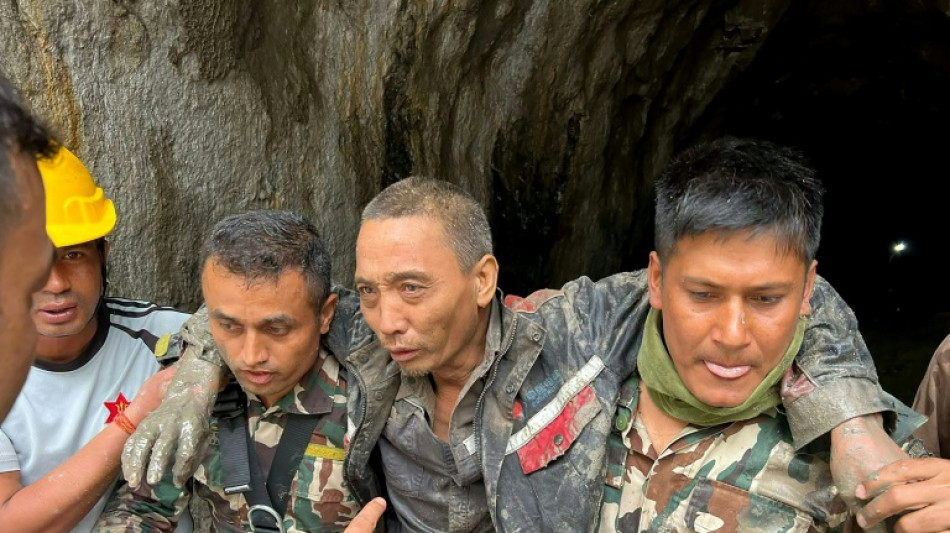
Two Nepal rescues revive hopes 10 days after flood / Photo: Handout - Nepal Army Facebook Page/AFP
Rescuers in Nepal pulled alive on Saturday a Chinese national from a tunnel and a local woman from her partially submerged home, as emergency response teams searched with renewed vigour for thousands missing since catastrophic flooding 10 days ago.
A rescue team comprising personnel from the Nepal Army and foreign experts rescued the Chinese man from 225 metres (738 feet) inside the tunnel of the Upper Trishuli-1 Hydropower Project in Rasuwa district, a military statement said.
A picture of the rescue published on the army's Facebook page showed the man, identified only as Luhaitao, with his arms around the shoulders of two camouflage-clad rescuers.
He appeared alert, but his hands were covered in thick, wet mud.
"His health is currently being assessed and further search and rescue operations are continuing," the army said.
The man was among hundreds of hydropower workers who went missing after a tsunami-like wall of water and mud swept through the China-Nepal border following a vast glacial and rock collapse on August 26.
Authorities later in the day said members of Nepal's Armed Police Force pulled alive Chandrika Shrestha, 64, from her buried home in Nuwakot district.
"A police team found her as they were clearing the area. She has been airlifted to Kathmandu for treatment," police deputy superintendent Iqbal Hawari told AFP.
A video released by Nepal's Armed Police Force showed only part of her house visible, with the lower floors submerged by thick sludge.
On Friday, two Nepali hydropower workers were rescued at the Trishuli 3A tunnel, where searches continued alongside multiple other sites, with at least 12 hydropower projects destroyed by the floods.
Both men were reported to be in stable condition in a Kathmandu hospital.
So far, 1,344 bodies have been recovered in Nepal, according to the national disaster agency, with around 5,000 people missing.
In China, state media said 31 people had been killed and 531 were missing.
That takes the overall death toll to 1,375 people, and more than 5,500 missing.
- Thousands in relief camps -
The government initially said it believed more than 100 workers could be alive inside multiple tunnels.
Experts from India, China, Australia and South Korea have been aiding Nepali rescuers in their search of survivors inside the blocked tunnels.
Rescuers have also been relying on drones to deliver medicine, food and other supplies, as well as transporting bodies, in high-altitude areas hard to reach by roads.
"We have sent a lot of relief material and right now our team is loading some materials for the hospital in the area," drone operator Avaya Pokharel told AFP in Nuwakot.
The United Nations has warned that the "magnitude of the destruction" makes delivering aid an immense challenge, launching a $50 million appeal to help more than 84,000 people affected by the disaster.
With morgues overflowing, some 1,030 bodies have been buried in mass graves after taking DNA samples for future identification, Nepal Police said on Saturday.
Prime Minister Balendra Shah promised to provide "safe and comfortable accommodation" for thousands of people displaced by the disaster and currently living in temporary relief camps.
"We know that staying there (in camps) is not easy for you," he said in a social media post on Friday.
He promised to "once again create an environment where you can dream about and build your future".
C.White--PI