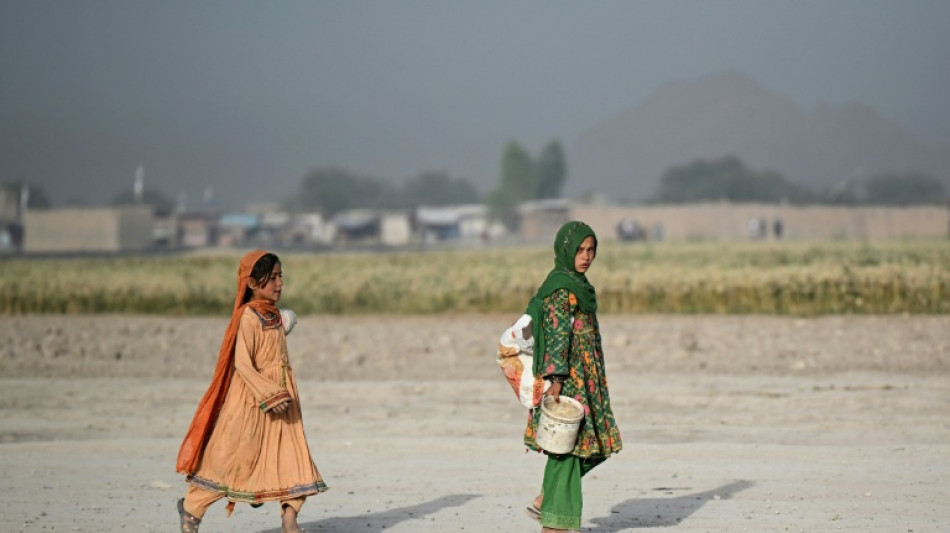
One million Afghan children suffer 'life-threatening' malnutrition: UN / Photo: Sanaullah SEIAM - AFP

One million children in Afghanistan are suffering from life-threatening malnutrition in a worsening crisis sweeping the country, the United Nations warned Tuesday.
Across Afghanistan, 3.7 million children suffer from wasting, meaning they are acutely malnourished, the UN children's agency UNICEF said.
Among them are "one million children who are suffering from life-threatening severe acute malnutrition" -- the worst form, said UNICEF's Afghanistan country representative Tajudeen Oyewale.
"If there is no treatment, and we are not able to act fast, that one million number are at risk of dying," he told reporters in Geneva, speaking from Kabul.
Afghanistan has endured repeated hunger emergencies in recent decades as it has struggled through civil war and other crises. An economic collapse followed the Taliban government's return to power after US-led forces withdrew in 2021.
"Malnutrition plays a central role" in the growing numbers of deaths of very young children, Oyewale said.
Nearly 40 percent of children admitted to hospitals with severe wasting and medical complications were babies under six months old, he said.
Meanwhile children under two years old make up more than 80 percent of severe acute malnutrition cases in Afghanistan.
He described a "worsening nutrition crisis" across the country, with more than half a million children admitted to hospital so far this year for high-risk moderate and severe wasting.
In July 2025, around 6,000 severe acute malnutrition cases were admitted; in July this year, the numbers went above 8,000 -- a third higher.
"In parts of southern Afghanistan, some hospitals are now seeing three or four severely malnourished children for every available bed," he warned.
- 'Vicious cycle' -
Oyewale said an "increasingly alarming picture" was developing, with families cutting back on nutritious food and meals becoming smaller.
Children's first food beyond breast milk may be little more than bread with tea, or watered-down yoghurt, "and for a growing child, this is simply not enough".
He said children could get trapped in a "vicious cycle": being poorly nourished, developing severe diarrhoea or respiratory infections, and then in turn becoming more malnourished.
These problems are compounded by Afghanistan's other troubles, such as successive years of drought, flash floods, regional instability and cross-border trade disruptions.
The return of six million Afghans from abroad since 2023 -- more than half of whom are children -- is also exacerbating the pressures on stretched resources.
While treatment for malnutrition can save lives, if survivors return home to the same conditions, "we frequently see those kind of children relapse and come back".
Oyewale said that while the needs were increasing, services for children were being slashed due to international aid cuts.
He said more than 100 sites treating children for severe wasting had closed since 2025.
UNICEF's nutrition programme in Afghanistan is estimated at $180 million this year but is only 22 percent funded.
"We should not wait until a child is dangerously thin and lying in a hospital bed before we act," Oyewale said.
A.Anderson--PI