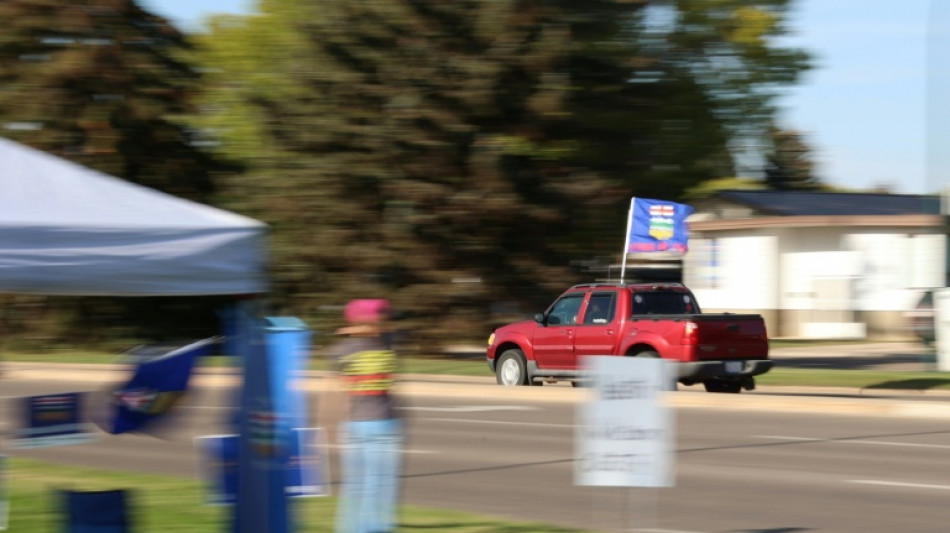
US influence, AI and mistrust cloud Alberta independence vote / Photo: ABED ZAQ - AFP

The run-up to a referendum in Canada's Alberta region on a future independence vote has been clouded by US political influence and AI-manipulated online content, leaving experts concerned that the results will be contested no matter the outcome.
Canadian Prime Minister Mark Carney said Thursday that he expected foreign governments -- the "United States included" -- would not get involved in Canadian elections.
But the US is already on the scene.
President Donald Trump has launched a trade war and repeatedly claimed that Canada should be incorporated into the United States.
US Treasury Secretary Scott Bessent has called Alberta a "natural partner," while Canada's Globe and Mail newspaper recently detailed contacts between separatist leaders in the province and US Republican operatives.
Canada's foreign influence transparency commissioner said in September his office was "aware of concerns" about non-Canadian activities around the Alberta referendum. The minority New Democratic Party (NDP) has advocated for a parliamentary debate on the issue.
"None of these things can be taken in a vacuum," NDP Member of Parliament Heather McPherson told AFP.
Close Trump allies have also inserted themselves into the online independence conversation.
Last week, tech billionaire Elon Musk posted on X after francophone Quebec's separatist party win: "They would be better off. Alberta and Saskatchewan should separate too."
Brian McQuinn, the co-director of the Centre for Artificial Intelligence, Data and Conflict at the University of Regina told AFP it "would be folly" to discount the impact this could have in Canada.
Along with Americans, McQuinn says he also observed Russian-linked activity pushing the most extreme aspects of the independence debate.
This may not directly sway voters but will at least raise the temperature, he said.
"If the fire is big and you fan it, it really gets bigger."
- AI amplification -
Separatist leader Mitch Sylvestre told AFP that US interests "don't play any role" in Alberta "until we win and become government."
He insisted his side has a high chance of winning.
However, polling firms place support for the future referendum option at about only a quarter of Alberta's population.
"A very likely result of this referendum is going to be a community that sees this election as stolen or at least unfair," said Aengus Bridgman, director of the Media Ecosystem Observatory (MEO) at McGill University.
Bridgman explained much of the separatist conversation online comes from authentic independence partisans, whose content is often boosted through widespread use of AI.
"Their online presence is made bigger through AI use," he said. "It makes it feel better resourced."
The MEO also reported on a network of AI-generated videos discussing separatism which garnered over 40 million views and was eventually linked to individuals in the Netherlands. But Bridgman said they appeared to be motivated by profit, not manipulation.
Even when AI content did not mislead, its mere presence helps to imply illegitimacy for voters, he said, increasing anxiety.
- Widespread distrust -
Bridgman said some -- not all -- separatists are motivated by pandemic-era grievances, with many independence influencers also having ties to the trucker convoy that occupied Ottawa in 2022.
"Their evidence of (Ottawa's alleged) authoritarianism is the Covid lockdown," he said.
Bridgman and political analyst Lori Williams both noted a general frustration and distrust in Alberta's election agency as well.
"Since there's such a large number of potential mail-in ballots and, of course, advance poll ballots involved in this election, people might raise those concerns as well," Williams said
She said this apprehension is widespread -- beyond separatists -- given the complicated referendum vote, which poses nine questions alongside the non-binding separation poll.
As Election Day approaches, AFP has already debunked fraud narratives about spoiled ballots and noncitizen voting.
Williams anticipates the lasting impact of attempts to influence Alberta's voters seems to be priming many to question the results come October 19.
S.Taylor--PI