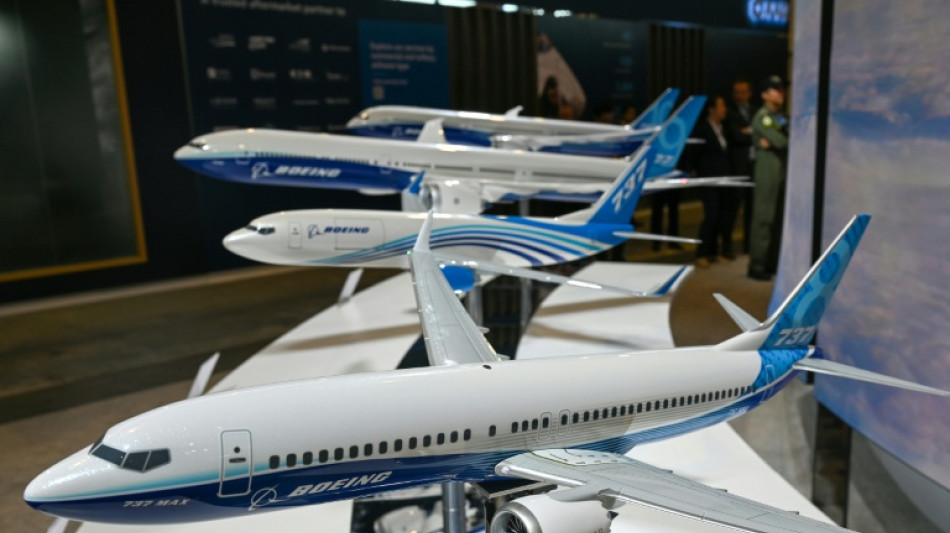
US regulators grant long-awaited Boeing 737 MAX 7 certificate / Photo: Roslan RAHMAN - AFP/File
More than eight years after Boeing organized the maiden flight of the 737 MAX 7, the aircraft has won certification, US authorities announced Monday.
The Federal Aviation Administration (FAA) announced certification of the smallest version of the single-aisle MAX plane, a process that had been significantly prolonged by new requirements under federal legislation following two fatal MAX crashes in 2018 and 2019.
FAA approval follows "almost a decade of extensive review," the agency said.
"The approval reflects years of sustained work to resolve complex technical issues and complete a thorough review of the airplane's design and supporting safety analyses."
Boeing had originally intended to commence deliveries in 2019 on the 737 MAX 7, which has a maximum of 172 seats.
But that timeframe fell by the wayside after the two fatal crashes, which were followed by a near-catastrophic January 2024 Alaska Airlines flight in which a fuselage panel blew out mid-flight.
To win certification, Boeing completed 441 flight tests over 686 test flight hours.
A contributing factor to the two fatal MAX crashes was the poor design of an anti-stall system known as the Maneuvering Characteristics Augmentation System (MCAS) that activated improperly and prevented pilots from regaining control of the planes.
US prosecutors charged that Boeing misled FAA regulators about MCAS, resulting in no reference to the system in manuals and pilot training materials.
Monday's announcement marks Boeing's first new aircraft certified since the safety problems that have engulfed the company in recent years.
Boeing is also close to winning certification for the 737 MAX 10, the largest in the MAX family with a maximum of 230 seats.
The certification process has included FAA reviews of a revamped enhanced angle of attack (AOA) sensor after a defect contributed to fatal 737 MAX crashes in 2018 and 2019 that led to a lengthy grounding.
Capitol Hill hearings exposed weak government oversight of Boeing as a factor in the MAX crashes, leading to 2020 legislation requiring the company to install new AOA sensors on the entire fleet of over 2,300 MAX planes within two years.
With the certifications moving ahead, Boeing expects to ramp up MAX production in the coming period.
Chief Executive Kelly Ortberg, who joined Boeing in August 2024 after the Alaska Airlines incident, has emphasized close adherence to quality control and key performance indicators.
The company has worked closely with the FAA, which greenlighted MAX production increases from 38 to 42 and then from 42 to 47.
Ortberg told a Wall Street conference in late May that it would take "a few months of stabilization" at the 47 level in terms of readying the supply chain while monitoring key performance indications.
Boeing in July unveiled a new MAX production line in Everett, Washington that is expected to enable the MAX program to meet 52 airplanes per month.
Ramping up output is essential to Boeing's medium-term financial targets, which includes the generation of $10 billion in annual free cash flow following a lengthy period of earnings underperformance.
K.King--PI