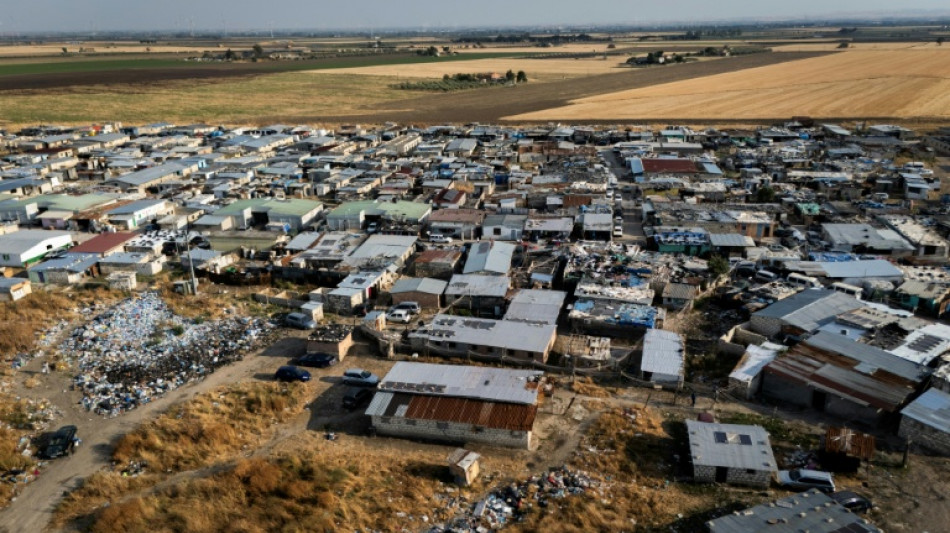
Farm workers wilt in sweltering Italian shanty town / Photo: Tiziana FABI - AFP
From sun-scorched fields of crops to the corrugated iron shacks of a sprawling shanty town, there is no escaping the heat for migrant labourers in southern Italy's Puglia region.
The smell of roasting goat and burning rubbish fill the air in the settlement, which spreads out between the disused runways of a former military airfield.
After hours of back-breaking work in the middle of a heatwave gripping Europe, the fruit pickers cycle back to Borgo Mezzanone, where there is no natural shade, no drinking water and no sanitary facilities.
"It is very difficult, very hot, we cannot sleep at night," Florence Ekhatoro, a 47-year-old from Nigeria, told AFP.
Despite the heat, she is preparing to light a fire under a grill on her doorstep to cook fish and meat pasties to sell.
Ekhatoro is one of the luckier inhabitants, managing to snap up a small brick shanty when she moved here nine years ago. A fan whirrs noisily below the pictures of saints hung on the walls.
Six plastic water containers sit inside the front door. Filling them is an arduous task, especially when violent summer storms turn the dirt tracks to mud.
Residents use a shopping trolley to haul containers back and forth from two water tanks provided by local authorities, then boil the water for drinking or washing.
"It's hard... some people go to work, come back, and go to sleep without washing," said Mamadou Sarafou Diallo, a 40-year-old from Guinea.
- 'Inhumane living conditions' -
The shanty town on the outskirts of Foggia has existed since 2005 and swells to an estimated 4,000 people in peak summer months, when seasonal workers come to pick melons, apricots and cherries.
Italy was awarded some 54 million euros ($62 million) from the EU to move the workers into proper housing, but despite appointing a special commissioner it failed to spend it before the deadline, forfeiting the funds.
Member of parliament Marco Pellegrini, who hails from Foggia and has visited the shanty town, slammed the "inhumane living conditions" inside Borgo Mezzanone in a ministerial question earlier this month.
The loss of the EU funds was a "complete failure" by Giorgia Meloni's right-wing coalition, Pellegrini, a member of the opposition Five Stars (M5S) party, told AFP.
He suspected the government of stalling because it "did not look favourably on the attempt to regularise" the migrants, some of whom are in Italy illegally.
The ministry in charge did not immediately reply to a request for comment.
"The migrants are often exploited, forced to work at an exhausting pace in the fields for very low pay, then returning to a punishing ghetto," Pellegrini said.
- 'Desert-like' -
Living in the "desert-like" settlement leaves the workers at higher risk of physical and mental health issues, doctor Camilla Faragona told AFP.
Faragona works with humanitarian organisation Intersos, which provides free health and social assistance.
"We're talking about young, healthy individuals, who perhaps arrived in Italy recently, but whose health is deteriorating year after year due to these living conditions and labour exploitation", she said.
Francesca Palazzo, Intersos' project leader in Foggia, said "people returning from the fields cannot cool down".
"They suffer from heat, from thirst. When they visit our clinic in this period, it's mostly for heat-related problems."
As she speaks, labourers queue up at the mobile clinic, parked on the shanty town's outskirts, where diseased dogs beg for water and cows destined for the shanty town's slaughterhouse graze on rubbish mounds.
Palazzo remembers a previous heatwave when she came across one young man crying outside his hut.
"He was lonely and had taken in a couple of stray puppies. But they had died in the heat," she said.
L.Stewart--PI