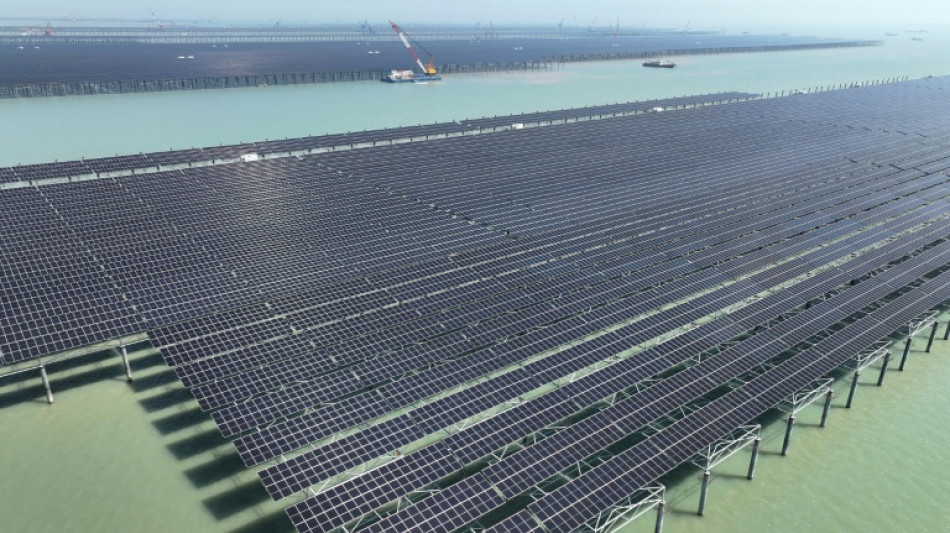
Mideast war lights fire under energy transition plans / Photo: - - CN-STR/AFP

Painful surges in oil prices are spurring countries to quickly rethink how to reduce dependence on fossil fuels, as shortage risks from war in the Middle East grow greater by the day.
Britain's government on Tuesday was the latest to unveil its plans, vowing to "massively expand renewables" as a way of bolstering energy security while denting the impact of higher electricity and petrol costs.
Around 60 governments worldwide have announced strategic responses or reviews since US and Israeli forces began striking Iran on February 28, according to Carbon Brief, a specialised news site.
Using data from the International Energy Agency, Carbon Brief found many countries promising short-term relief such as cuts on fuel taxes or warning of rationing of fossil fuels.
But others have responded with plans to accelerate their green energy transitions toward low-carbon sources.
- France -
France announced on April 10 a range of measures to speed up the electrification of construction, transport and other industries, to reduce the share of fossil fuels in the country's energy mix to just 29 percent by 2035 from 60 percent today.
Electric vehicles should make up two out of every three new car sales by 2030, Prime Minister Sebastien Lecornu said.
The government is also providing aid to spur the installation of one million heat pumps a year, reducing reliance on imported natural gas.
- EU -
EU Commission President Ursula von der Leyen has promised to propel the continent's electrification with announces planned for April 22.
- Sweden -
Sweden's environment minister announced on April 7 that "electrification is the future" to protect citizens from surging oil and natural gas prices.
The two key measures were increased aid for using renewable energies by government employees and household subsidies for EV purchases.
- China -
President Xi Jingping promised this month that "A greener, more diversified and resilient new energy system will provide a strong guarantee for China's energy security and economic development," state-controlled CCTV said.
- Philippines
Energy Secretary Sharon Garin said in late March that "amid the Middle East conflict, accelerating the development of renewable energy and storage is both a strategic necessity and a national imperative".
The archipelago nation relies on coal for about 60 percent of its electricity generation, and President Ferdinand Marcos has declared a "national energy emergency" due to risks to the domestic fuel supply.
- Japan -
Even as it authorised more burning of coal for power plants in response to soaring oil prices, Japan's government reiterated plans to "maximise the use of both renewable energy and nuclear power" to ensure its economic growth.
It announced on March 20 a $40 billion project with Washington to build next-generation small nuclear power plants in Tennessee and Alabama, which could expand Japan's own network of nuclear plants.
- India -
After cutting fuel taxes in late March to soften the blow at petrol stations, the Indian government said it would speed up permit grants for wind turbine and battery electricity storage projects.
- Cambodia -
Cambodia, which imports all its consumer fuel, announced in late March it was cutting import tariffs from 35 percent to zero on electric vehicles, electric kitchen stoves, and solar energy.
It also cut tariffs on rechargeable hybrid vehicles to just seven percent from 35 percent.
- Barbados -
The Caribbean island's government unveiled in early March a $81 million plan to shift away from fossil fuels with heavy investments in renewable sources, in particular wind farms.
The goal is also to reinforce energy stockage capacities.
- Kenya -
President William Ruto announced in late March a plan to triple electricity production in the next five to seven years, with nuclear energy accounting for just under a third of the country's needs.
"We have made a deliberate and strategic decision to significantly expand our energy capacity," Ruto said.
E.Adams--PI