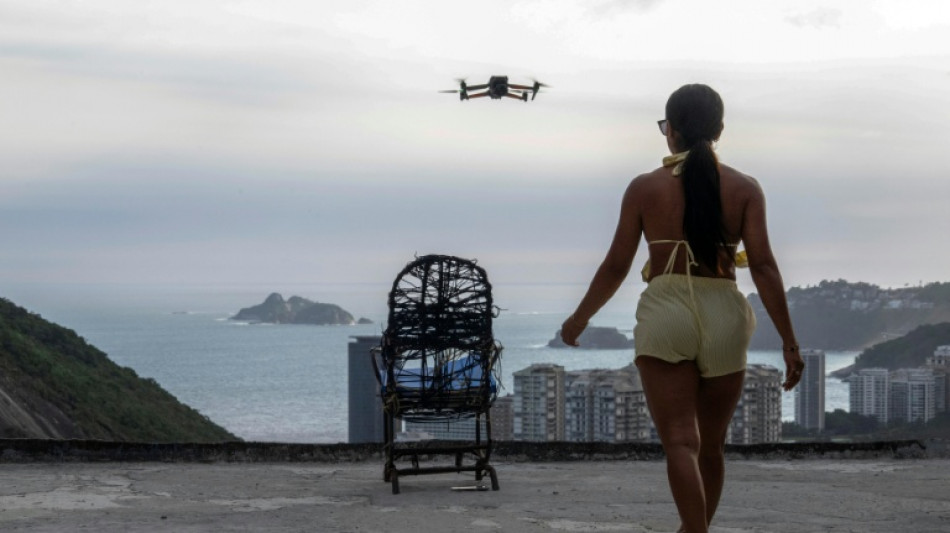
Viral drone video fuels debate about Rio favela tourism / Photo: Pablo PORCIUNCULA - AFP

A line of tourists touch up their makeup before strutting across a rooftop in Rio de Janeiro's largest favela, posing for a drone as it zooms out to show dramatic aerial views of the hillside community.
Set to an infectious beat, the video of the Rocinha favela has exploded on social media at a time when the city is drawing record tourist numbers.
It has also created a sense of unease, with dozens of comments accusing visitors of glamorizing poverty and crime in a low-income community dominated by drug traffickers.
However, Renan Monteiro, 42, founder of the tourism company Na Favela Turismo, told AFP that the drone footage was the fruit of efforts to show tourists "the positive side of the favela."
"We are not romanticizing poverty. We want to change the prejudice that exists in people's minds."
He explained that tourists cannot just go to the Porta do Ceu (Gate of Heaven) rooftop, where there has at times been a wait of up to two hours for the drone selfie, which costs at least 150 reais ($30).
They can only get there via a tour, navigating a maze of narrow alleyways as residents go about their daily lives while stopping to visit local artists or see a capoeira show.
Rocinha "has this image that it's kind of bad, kind of dangerous...I found it really lovely to see the atmosphere," said Gabriel Pai, 38, a delivery worker from Costa Rica, after posing for his drone shot.
The success of the drone video has drawn influencers, local officials, and even a marriage proposal.
Ingrid Ohara, a Brazilian influencer with 12 million followers on Instagram and 20 million on TikTok, walks across the rooftop in a shower cap and towel, which she casts aside to reveal a skimpy dress, twirling as the drone zooms away.
"These videos I make always get a lot of views, and so I wanted to make one here in Rocinha because it's going viral all over the world," she told AFP.
She said the videos were "showing our country, showing our Rio de Janeiro, this is part of our culture."
- 'Safari-like tourism' -
Monteiro, who grew up in Rocinha, recalls the early days of "safari-like" tourism in the favela, when visitors guided by outsiders would show up in open-air jeeps, much to the chagrin of locals.
In 2017, a female Spanish tourist was shot dead during a firefight between police and drug traffickers, and all tourism stopped.
When it resumed years later, visitors were once again "wandering around on the wrong paths" with no oversight.
Monteiro was inspired to find a safe way to show visitors the sprawling favela, which is home to over 70,000 people.
Working with community leaders, he mapped out set tourist routes, monitored by locals. He also created an app to track guides' locations and manage the flow of tourists.
If there is a police operation against drug traffickers, guides communicate through the app to cancel ongoing tours.
The company has trained 300 local guides and ten drone pilots. The owners of 26 rooftops and terraces in Rocinha and Vidigal earn money for allowing tourist visits.
Drone pilot Pedro Lucas, 19, said he had few prospects before the job, which "changed my life a lot."
"I earn a good amount of money and it would be good if more people from the favela had the same opportunity."
- 'An exotic contrast' -
With world-famous beaches, Carnival, and sights like the Christ the Redeemer statue, tourism in Rio has surged.
Government tourism agency Embratur told AFP there were almost 290,000 international visitors in January alone, a record.
In February, Na Favela Turismo recorded 41,000 visitors to Rocinha and nearby Vidigal.
Claudiane Pereira dos Santos, 50, a cleaner, welcomes the tourist "frenzy."
"People immediately associate (Rocinha) with crime, the bad side. And it's not like that. There are many hardworking people, wonderful people."
If people want to criticize something, she added, they could focus on the lack of basic services and electricity that residents struggle with.
"I recognize that some residents see this as a legitimate source of income," said Cecilia Olliveira, Executive Director of the Fogo Cruzado Institute, which tracks armed violence in low-income communities.
"The problem arises when the favela ceases to be a vibrant, complex neighborhood traversed by structural inequalities and becomes merely an exotic contrast or a backdrop for impactful content."
S.Phillips--PI