Families want answers a year after South Korea's deadliest plane crash / Photo: ANTHONY WALLACE - AFP

Grieving mother Lee Hyo-eun returns every weekend to the airport where her daughter and 178 others died last year, desperate for the truth about South Korea's deadliest airline disaster.
Jeju Air Flight 2216 was coming in to land at Muan International Airport from Thailand when it struck a flock of birds and was forced to make a belly landing that sent it crashing into a structure at the end of the runway.
Only two flight attendants seated in the tail section survived.
Lee vividly remembers that day.
Her daughter Ye-won, a cello instructor, had just celebrated her birthday and was due to return from a short holiday in Bangkok.
Lee was planning a welcome dinner when her sister called to ask if Ye-won had landed.
What happened next, she said, was "unbelievable".
"She was gone when she was at her brightest, in full bloom at 24," Lee said.
Official findings have pointed to pilot error in explaining why the December 29, 2024 crash happened.
But one year on, Lee and other relatives of the victims say they harbour deep mistrust over how the investigation has been handled.
They are still demanding answers over the key question surrounding the crash: why was there a concrete block at the end of the runway, despite international aviation safety guidelines?
- 'We demand answers' -
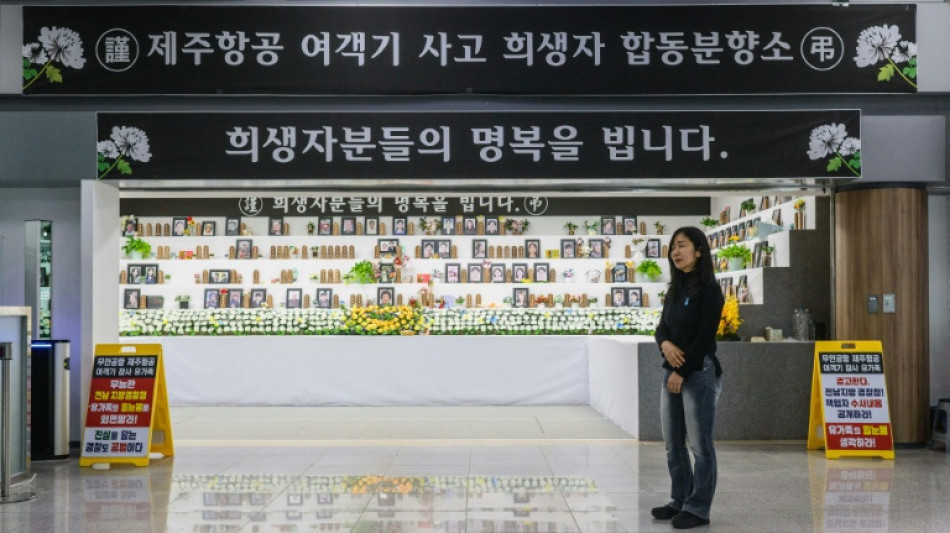
At the Muan airport -- which has been closed to commercial flights since the crash -- families of the victims spend days and nights in and around tents set up in the departure terminal on the second floor.
Blue ribbons symbolising the victims adorn the airport, while letters remembering the dead line the stairways.
The localisers damaged in the crash still stand at the end of the runway, and what appear to be fragments of concrete slabs and pillars are strewn across a field not far away.
Banners draped along the walls criticise the official investigation, with one reading: "A country incapable of protecting citizens is not a country. We demand answers!"
Park In-wook told AFP he is "famous" among the two dozen relatives who choose to return to the airport weekend after weekend.
He lost five loved ones in the crash: his wife, daughter, son-in-law and two young grandchildren.
"In the first days, I felt like I was dreaming," said Park, 70.
"Almost a year has passed, but I cannot recall how many days it took to hold my wife's funeral or the exact date it took place."
The families' anger intensified following the release of an interim investigation report in July.
The report emphasised that the pilot decided to shut down the less damaged left engine during the crash, but it did not address the concrete structure housing antenna localisers at the end of the runway.
International aviation safety guidelines state that such navigation structures should be made of frangible, or breakable, material -- a recommendation not followed at the Muan airport.
A nationwide inspection after the crash found six other airports where localisers were also housed in concrete or steel structures.
Five of them have had their localisers retrofitted with breakable material, while another will be retrofitted next year, Seoul's transport ministry told AFP.
"The July report highlights the government's attempt to frame the accident as being caused mainly by pilot error," Ko Jae-seung, 43, who lost both parents in the crash, said.
"An official investigation should not be about assigning blame to individuals but about examining the systems and conditions that made the accident inevitable," Ko said.
- 'Everyone could have survived' -
Ye-won's mother believes the pilots did everything they could in those crucial moments to save lives on board.
"They managed to land the plane on its belly against all odds, with everyone still alive at that point, without knowing there was a concrete structure ahead of them," she told AFP at her home in the southwestern city of Gwangju.
"Everyone could have survived -- only with injuries -- if it had been a mound of earth."
Her home is decorated with photographs of her late daughter alongside handwritten letters from Ye-won's friends.
"Thank you for everything. You were a deeply respected and beloved teacher," the mother of one student wrote.
On a cabinet sit several framed photos from Ye-won's final days in Bangkok, retrieved from her phone, which was discovered at the crash site.
"Sometimes it feels like she just hasn't come home from her vacation," Lee said.
"I find myself wondering when she will."
W.Wright--PI